
Strategies for Supporting Children with Autism in Early Years
Introduction
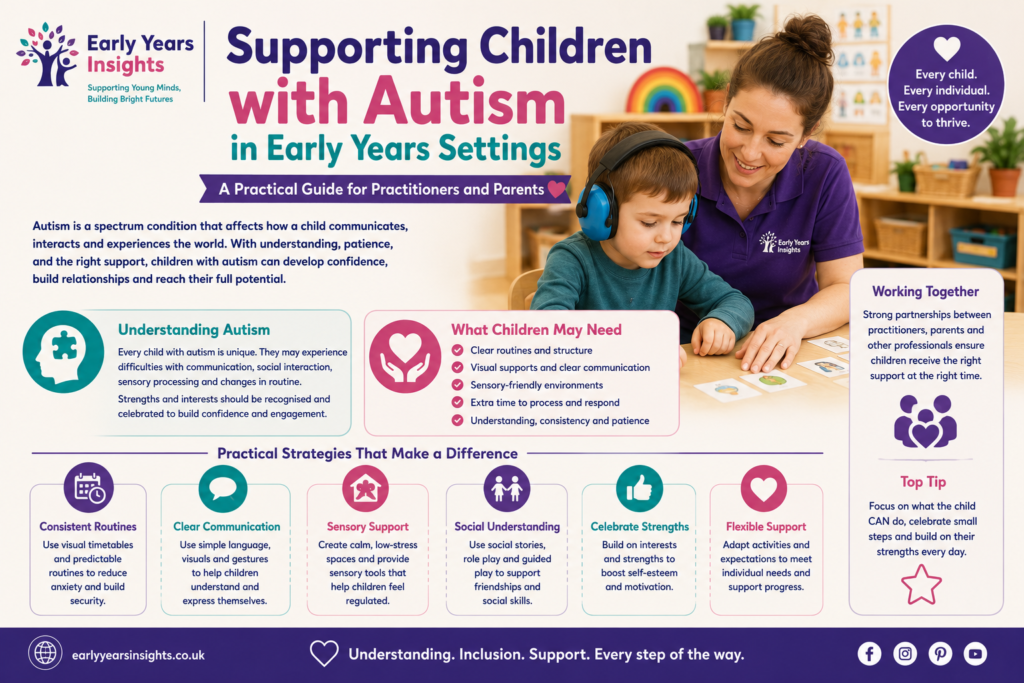
Supporting Children with Autism in Early Years requires understanding each child’s individual strengths, communication style, sensory needs, and ways of learning. Early identification and inclusive practice can help autistic children feel safe, valued, and supported.
Every child is unique, with their own personality, interests, strengths, and ways of experiencing the world. For autistic children, understanding their individual needs and providing appropriate support can make a significant difference to their confidence, development, learning, and overall wellbeing.
Autism is a lifelong neurodevelopmental difference that affects how a person communicates, interacts with others, and experiences the world around them. Autism exists on a spectrum, which means that every autistic child is different. Some children may need significant levels of support in their daily lives, while others may require minimal support. There is no single way that autism looks or presents in children.
In early years settings, creating an inclusive, understanding, and supportive environment helps autistic children feel safe, valued, and able to participate in learning and play. Effective support does not mean changing who a child is; rather, it involves adapting the environment, communication methods, and teaching approaches to meet their individual needs.
This guide explores practical strategies that early years practitioners, teachers, and parents can use to support autistic children, promote inclusion, and celebrate their strengths.
Table of Contents
Why Supporting Children with Autism in Early Years Matters
Supporting Children with Autism in Early Years helps practitioners understand each child’s individual strengths, communication preferences, and sensory needs. Through inclusive practice, early years professionals can create environments where autistic children feel safe, valued, and able to achieve their full potential.
Understanding Autism
Autism, also known as Autism Spectrum Disorder (ASD), is a developmental difference that affects how people understand and respond to the world around them. It is usually identified during childhood, although some people receive a diagnosis later in life.
Autistic children may experience differences in areas such as communication, social interaction, sensory processing, and behaviour. However, it is important to remember that these characteristics vary greatly from one child to another.
Communication Differences
Some autistic children may use spoken language confidently, while others may communicate using fewer words or use alternative methods of communication such as gestures, pictures, signs, or communication devices.
Early years practitioners can support communication by:
- Using clear and simple language.
- Giving children extra time to process information and respond.
- Using visual supports such as pictures, symbols, and visual timetables.
- Paying attention to non-verbal communication, such as facial expressions, body language, and gestures.
- Respecting the child’s preferred way of communicating.
Social Interaction Differences
Some autistic children may find social situations challenging. They may prefer to play alone, have difficulty understanding social rules, or find it difficult to recognise another person’s emotions.
Practitioners can support social development by:
- Following the child’s interests to build positive interactions.
- Providing opportunities for shared play without forcing participation.
- Modelling social communication during everyday activities.
- Supporting friendships and helping peers understand and respect differences.
Sensory Differences
Many autistic children experience the world differently through their senses. They may be more sensitive or less sensitive to sounds, lights, textures, tastes, smells, or movement.
For example, a busy and noisy classroom may feel overwhelming for some children, while others may actively seek sensory experiences such as movement, touch, or certain sounds.
Understanding a child’s sensory preferences allows practitioners to make reasonable adjustments, such as creating quiet spaces, reducing unnecessary noise, providing sensory resources, or adapting activities to make them more comfortable and accessible.
Recognising Each Child as an Individual
Although autism has common characteristics, no two autistic children are exactly the same. One child may enjoy group activities and communicate using speech, while another may prefer independent play and communicate using visual supports.
A child-centred approach is essential. Practitioners should take time to observe children carefully, understand their strengths and interests, identify any areas where additional support may be needed, and adapt their practice accordingly.
Working closely with parents and carers is also important because families have valuable knowledge about their child’s routines, preferences, communication styles, and successful strategies used at home.
Creating an Autism-Friendly Learning Environment
The learning environment plays an important role in helping autistic children feel safe, comfortable, and ready to learn. Many autistic children benefit from environments that are predictable, organised, and responsive to their individual sensory and communication needs.
Early years practitioners should consider how the physical environment, daily routines, and teaching approaches can be adapted to create an inclusive space where every child can thrive.
Establishing Predictable Routines
Many autistic children feel more secure when they know what to expect throughout the day. Unexpected changes or unclear transitions can sometimes cause anxiety or distress.
Practitioners can support children by:
- Creating consistent daily routines.
- Using visual timetables to show the sequence of activities.
- Giving advance warnings before transitions, such as “In five minutes, we will tidy up and go outside.”
- Preparing children for changes in routine whenever possible.
A predictable environment helps children develop confidence, independence, and a greater sense of security.
Using Visual Supports
Visual supports can make information easier for many autistic children to understand and remember. Pictures, symbols, photographs, and written words can provide clear guidance and reduce confusion.
Examples of visual supports include:
- Visual timetables showing the order of the day.
- Choice boards that allow children to select activities or resources.
- Picture cards to support communication.
- Labels with words and images on storage areas.
- Visual reminders of classroom expectations.
Visual supports should be individualised because different children will benefit from different types of information.
Creating a Sensory-Friendly Environment
Some autistic children may be highly sensitive to sensory experiences, while others may seek additional sensory input. Understanding these differences helps practitioners create an environment where children can feel calm and focused.
Practical strategies include:
- Reducing unnecessary background noise where possible.
- Using calm and organised classroom layouts.
- Providing a quiet space where children can take a break when feeling overwhelmed.
- Offering sensory resources such as fidget tools, weighted items (where appropriate), or movement opportunities.
- Considering lighting, smells, and textures within the setting.
Observing how a child responds to their environment is the best way to understand what supports they may need.
Supporting Communication and Language Development
Communication is an essential part of learning, building relationships, and expressing needs and feelings. Autistic children may communicate in many different ways, and all forms of communication should be recognised and respected.
Using Clear and Simple Language
Some children may find it difficult to process long or complex instructions. Practitioners can support understanding by:
- Using short and clear sentences.
- Giving one instruction at a time when needed.
- Avoiding unnecessary language.
- Allowing extra time for the child to process information before expecting a response.
Patience is important. Some children may need additional time to understand questions and formulate their responses.
Supporting Alternative Forms of Communication
Not all autistic children use spoken language as their main method of communication. Some may communicate through gestures, signs, pictures, communication books, or electronic devices.
Practitioners should:
- Value all attempts to communicate.
- Respond positively to non-verbal communication.
- Use communication tools consistently.
- Work with families and specialists to understand the child’s preferred communication methods.
The goal is not to force a child to communicate in a particular way but to ensure they have effective ways to express themselves.
Supporting Play and Social Interaction
Play is a powerful way for children to explore, learn, and develop relationships. Autistic children may have different ways of playing and interacting, and these differences should be understood and respected.
Following the Child’s Interests
A child’s interests can be a valuable starting point for engagement and learning. Practitioners can use favourite toys, activities, or topics to encourage communication, shared attention, and enjoyment.
For example, if a child has a strong interest in vehicles, practitioners can use cars, buses, or trains to introduce counting, storytelling, turn-taking, and imaginative play.
Encouraging Positive Social Experiences
Social interaction should be supported naturally rather than forced. Some useful approaches include:
- Creating small group activities based on shared interests.
- Modelling language and social skills during play.
- Helping children understand emotions and social situations.
- Encouraging peers to be accepting and inclusive.
- Celebrating different ways of interacting and playing.
Every child has their own social preferences, and respecting these preferences helps build trust and confidence.
The Importance of Supporting Children with Autism in Early Years
Supporting Children with Autism in Early Years is about recognising each child’s unique strengths, interests, communication style, and sensory needs. Early years practitioners can make positive adjustments that help autistic children feel secure, included, and confident.
A successful approach to Supporting Children with Autism in Early Years includes working closely with parents, using visual supports, creating predictable routines, and adapting learning experiences to meet individual needs.
Supporting Sensory Needs and Emotional Regulation
Autistic children may experience emotions and sensory information differently. Some children may become overwhelmed by loud noises, bright lights, crowded spaces, unexpected changes, or difficult situations. Understanding the reasons behind a child’s response helps practitioners provide appropriate and compassionate support.
Understanding Sensory Differences
Sensory differences can affect how a child experiences their environment. Some children may be highly sensitive to certain sensations, while others may seek additional sensory input.
Examples include:
- Covering their ears due to loud sounds.
- Avoiding certain clothing materials or food textures.
- Seeking movement by jumping, spinning, or climbing.
- Enjoying particular sounds, lights, or sensory experiences.
Practitioners can support sensory needs by:
- Observing what triggers discomfort or helps the child feel calm.
- Providing sensory breaks throughout the day.
- Offering suitable sensory resources.
- Creating calm areas where children can relax and regulate their emotions.
- Making reasonable adjustments to the environment.
Supporting Emotional Regulation
Emotional regulation is the ability to recognise, understand, and manage emotions. Some autistic children may find this more challenging, particularly when they are overwhelmed, anxious, or unable to communicate their needs.
Support strategies include:
- Maintaining a calm and reassuring approach.
- Helping children identify and express their feelings.
- Using visual supports such as emotion cards or feelings charts.
- Teaching calming strategies, such as breathing exercises or taking a break.
- Providing reassurance and consistency.
Building emotional regulation takes time and requires patience, understanding, and a strong relationship with trusted adults.
Understanding Behaviour as Communication
All behaviour has a reason or purpose. For autistic children, behaviour may be a way of communicating feelings, needs, discomfort, anxiety, excitement, or sensory overload.
Instead of asking, “How can we stop this behaviour?”, practitioners should consider, “What is the child trying to communicate?”
For example, a child who becomes upset during a noisy group activity may not be refusing to participate; they may be experiencing sensory overwhelm or finding the situation too difficult to manage.
Positive approaches to supporting behaviour include:
- Identifying possible triggers and patterns.
- Adapting the environment to reduce unnecessary stress.
- Teaching alternative ways to communicate needs.
- Using consistent and supportive responses.
- Recognising and celebrating positive achievements.
A compassionate and understanding approach helps children feel safe, respected, and supported.
Working in Partnership with Parents, Carers, and Professionals
Successful support for autistic children depends on strong partnerships between early years settings, families, and professionals.
Parents and carers know their children best and can provide valuable information about their interests, communication styles, routines, challenges, and effective strategies used at home.
Practitioners should:
- Listen carefully to families and respect their experiences.
- Share observations and celebrate progress.
- Work collaboratively to create consistent strategies between home and the setting.
- Communicate openly and honestly about any concerns.
Working with Special Educational Needs Coordinators (SENCOs), speech and language therapists, occupational therapists, and other professionals can also help identify effective strategies and ensure that children receive the support they need.
Promoting Inclusion and Celebrating Strengths
An inclusive environment recognises that every child belongs and has the right to participate fully in learning and play.
Autistic children often have many strengths, including creativity, excellent memory, attention to detail, honesty, determination, and deep interests in particular subjects. Recognising and building on these strengths helps develop confidence and self-esteem.
Inclusive practice means adapting the environment and teaching methods to meet the needs of all children rather than expecting children to fit into a single way of learning.
By promoting acceptance, understanding, and respect for differences, early years settings can help all children develop positive relationships and a strong sense of belonging.
Frequently Asked Questions (FAQs)
What is autism?
Autism is a lifelong neurodevelopmental difference that affects how a person communicates, interacts with others, and experiences the world. Autism is a spectrum, meaning every autistic person has their own unique strengths, needs, and experiences.
What are the early signs of autism in young children?
Early signs may include differences in communication, social interaction, play, sensory responses, and behaviour. Examples may include limited use of gestures, difficulties with changes in routine, intense interests, or unusual responses to sensory experiences. However, every child develops differently, and these signs do not always mean a child is autistic.
How can early years practitioners support autistic children?
Practitioners can support autistic children by creating predictable routines, using visual supports, adapting the environment, understanding sensory needs, supporting communication, and working closely with families.
Do all autistic children have the same needs?
No. Autism is a spectrum, and every autistic child is different. Support should always be based on the individual child’s strengths, interests, and needs.
How can sensory differences affect a child’s learning?
Sensory differences can influence concentration, participation, communication, and emotional regulation. Making suitable environmental adjustments can help children feel more comfortable and ready to learn.
Should autistic children be encouraged to join all group activities?
Children should be encouraged to participate in ways that are comfortable and meaningful for them. Practitioners should provide opportunities and support without forcing interaction, while respecting individual preferences.
How can practitioners support autistic children in early years settings?
Supporting children with autism in early years requires understanding their individual needs, using clear communication, creating structured routines, and providing sensory-friendly environments.
Why is early identification important for autism?
Early identification allows practitioners and families to provide appropriate strategies, specialist support, and inclusive experiences that help children reach their potential.
How can parents and practitioners work together?
Strong partnerships between parents and practitioners ensure consistent approaches, shared goals, and better outcomes for autistic children.
How can early years settings create an autism-friendly environment?
An autism-friendly early years environment provides predictable routines, visual supports, quiet spaces, sensory considerations, and positive relationships that help autistic children feel secure and included.
⭐ Key Takeaways
✔ Every autistic child is unique and has individual strengths and needs.
✔ Positive relationships and inclusive environments support learning and development.
✔ Visual supports, routines, and sensory considerations can help children feel secure.
✔ Working with families and professionals ensures the best support for each child.
✔ Early identification and appropriate strategies can make a significant difference to a child’s confidence, communication, and overall wellbeing.
Conclusion
Supporting children with autism requires patience, understanding, flexibility, and a commitment to inclusive practice. Every autistic child is unique and deserves to be valued for who they are.
By creating supportive environments, adapting communication methods, recognising sensory needs, working closely with families, and celebrating individual strengths, early years practitioners can help autistic children develop confidence, independence, and a genuine sense of belonging.
When practitioners focus on understanding the child rather than changing the child, they create a positive and inclusive learning environment where every child has the opportunity to thrive.
urther Reading and Professional Guidance
1. National Autistic Society – Autism and Early Years
Provides practical advice, resources, and guidance to support autistic children in early years settings.
National Autistic Society – Early Years and Autism
2. NHS – Autism Information for Parents and Professionals
Provides trusted information about autism, signs, assessment, and support available for children and families.
3. GOV.UK – SEND Code of Practice (0 to 25 Years)
The statutory SEND Code of Practice explains the duties of early years providers, schools, and local authorities in supporting children with special educational needs and disabilities.
GOV.UK – SEND Code of Practice: 0 to 25 Years