
Table of Contents
Ofsted Changes 2026 Early Years: What Practitioners Need to Know
Ofsted Changes 2026 Early Years bring important updates that every practitioner should understand to confidently prepare for inspections and provide high-quality education and care.
Introduction
Ofsted inspections are an important part of ensuring that children receive high-quality care, education, and support in early years settings. The changes introduced in 2026 aim to provide a clearer understanding of the quality of experiences children receive every day and how settings continuously improve their practice.
Early years practitioners should not only understand policies and procedures but also be able to confidently explain why they do what they do and how their practice positively impacts children’s learning, development, safety, and wellbeing.
The Ofsted Changes 2026 Early Years bring important updates that every practitioner should understand to confidently prepare for inspections.
At Early Years Insight, we have created this guide to explain the key Ofsted expectations for 2026, the areas inspectors may focus on, and common questions practitioners may be asked during an inspection.
Understanding the New Ofsted Approach
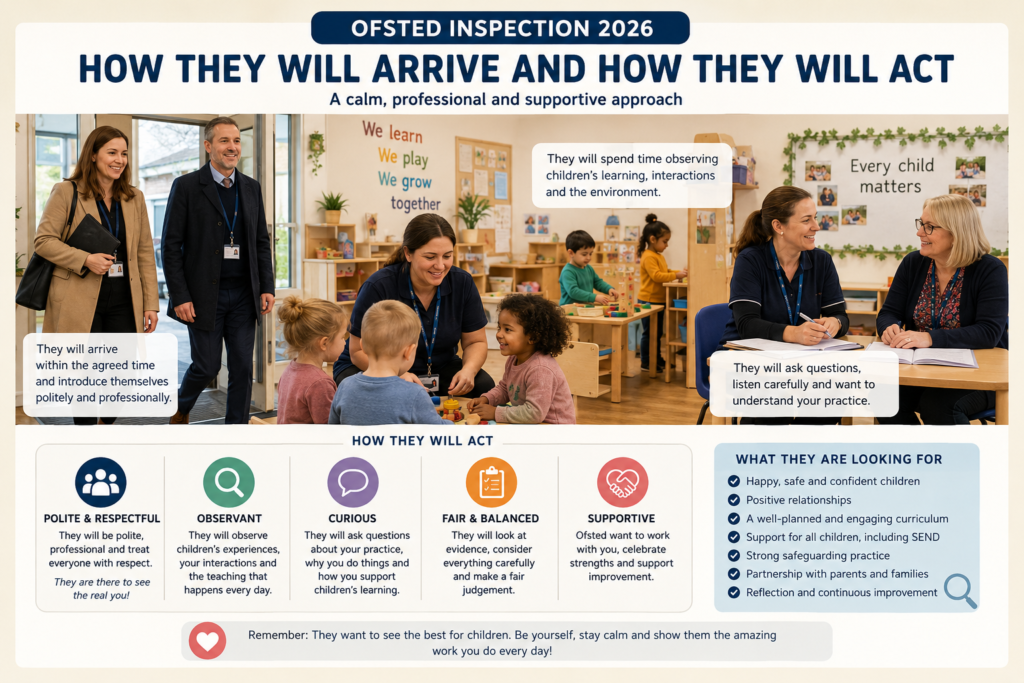
In 2026 early years inspections focus on the real experiences of children. Inspectors may spend time observing interactions, speaking with practitioners, and exploring how the environment, activities, and relationships support children’s development.
A successful inspection is about showing that practitioners understand the children in their care and make thoughtful decisions based on each child’s individual needs. not about having perfect paperwork or memorising prepared answers.
Understanding the Ofsted Changes 2026 Early Years helps practitioners strengthen their daily practice and prepare for inspection discussions.
For example, a practitioner should be able to explain why a particular activity was planned and what learning opportunities it provides.
Example:
A group of children show an interest in planting flowers in the garden. Rather than simply providing a planting activity, the practitioner extends the learning by discussing how plants grow, introducing new vocabulary such as roots, stem, and soil, encouraging children to count seeds, and allowing them to record changes over time through drawings and photographs.
This supports communication and language, understanding of the world, mathematics, and curiosity.
1. Safeguarding and Child Protection
Safeguarding is always a priority during an Ofsted inspection. Every member of staff has a responsibility to protect children from harm and promote their welfare.
Inspectors may ask practitioners about:
- Signs and indicators of abuse or neglect
- Recording and reporting concerns
- The role of the Designated Safeguarding Lead (DSL)
- Safer working practices
- Daily risk management
Common Ofsted Question
What would you do if you had a concern about a child?
Professional answer:
“If I had a concern about a child, I would remain calm, record my observations accurately using factual information, and report the concern immediately to the Designated Safeguarding Lead (DSL) in line with the setting’s safeguarding procedures.”
Practice Example
A practitioner may notice that a normally happy and sociable child has recently become withdrawn, appears unusually tired, and shows a significant change in behaviour.
Rather than making assumptions, the practitioner records exactly what they have observed, including dates and times, and follows the setting’s safeguarding procedures by sharing the information with the DSL.
2. Curriculum and Supporting Children’s Learning
Ofsted will explore how practitioners understand the curriculum and how they help children make progress.
Practitioners should be able to explain:
- What children are learning
- Why activities are provided
- How children’s interests influence planning
- How observations identify next steps
Common Ofsted Question
How do you know what a child needs to learn next?
Professional answer:
“I use my observations, knowledge of child development, and understanding of the child’s interests and abilities to identify their next steps. I then provide meaningful experiences that challenge and support their development.”
Practice Example
A child enjoys building tall towers with blocks every day.
The practitioner extends the learning by introducing different shapes and sizes, discussing mathematical language such as taller, shorter, heavier, and balance, and encouraging the child to draw a plan of their building.
This develops mathematical thinking, problem-solving, communication, and creativity.
3. SEND and Inclusive Practice
Every child is unique and should have equal opportunities to access learning and participate in the setting.
Inspectors may look at how practitioners:
- Identify additional needs early
- Adapt activities and environments
- Work with the SENCO and outside professionals
- Build strong partnerships with families
- Promote equality and inclusion
Understanding how to support children with additional needs is an important part of inclusive practice. You can read our guide on What is SEND in Early Years? for more information.
For practical strategies to support autistic children, read our article on Supporting Children with Autism in Early Years Settings.
Common Ofsted Question
How do you support a child with SEND?
Professional answer:
“I work closely with parents, the SENCO, and other professionals to understand the child’s individual needs. I adapt my communication, activities, and environment to ensure the child can participate and make progress.”
Practice Example
A child with communication difficulties may find transitions challenging.
The practitioner uses a visual timetable, simple instructions, and extra processing time to help the child understand routines and feel secure.
Small adjustments like these can make a significant difference to a child’s confidence, independence, and ability to engage with learning.
4. Behaviour, Emotional Wellbeing, and Relationships
Positive relationships are at the heart of effective early years practice. Children learn best when they feel safe, valued, and emotionally secure.
Inspectors may explore how practitioners:
- Support emotional regulation
- Promote positive behaviour
- Help children solve conflicts
- Build secure attachments
Common Ofsted Question
How do you support positive behaviour?
Professional answer:
“I build trusting relationships with children, recognise their feelings, and use consistent positive strategies to help them understand expectations and develop self-regulation skills.”
Practice Example
Two children may want the same toy and become upset.
The practitioner supports them by calmly acknowledging their feelings, encouraging them to use language to explain what happened, and helping them find a solution such as taking turns or choosing another activity.
This helps children develop empathy, communication, and problem-solving skills.
5. Communication and Language Development
Strong communication skills are the foundation for future learning. Practitioners should create language-rich environments through meaningful conversations, stories, songs, and play.
Common Ofsted Question
How do you support communication and language?
Professional answer:
“I engage children in high-quality interactions by listening carefully, introducing new vocabulary, and giving children time to express their thoughts and ideas.”
Practice Example
During snack time, a practitioner uses everyday conversations as learning opportunities.
Instead of asking questions that only require a “yes” or “no” answer, they ask open-ended questions such as:
- “What does your banana taste like?”
- “How does it feel?”
- “What other fruits have you tried?”
These interactions encourage children to expand their vocabulary and develop confidence when speaking.
6. Partnership with Parents and Families
Parents are a child’s first and most important educators. Effective partnerships help practitioners understand children’s interests, routines, strengths, and individual needs.
Common Ofsted Question
How do you work with parents?
Professional answer:
“I develop respectful relationships with parents through regular communication, sharing information about their child’s progress, and listening to their views and experiences.”
Practice Example
A parent shares that their child has become interested in dinosaurs at home.
The practitioner builds on this interest by providing dinosaur books, small-world toys, counting activities, and creative opportunities within the setting.
This creates consistency between home and the learning environment.
7. Keeping Children Safe Through Risk Assessment
Ofsted expects practitioners to balance safety with opportunities for children to take appropriate risks and develop confidence.
Common Ofsted Question
How do you keep children safe every day?
Professional answer:
“I maintain effective supervision, complete daily safety checks, follow the setting’s policies, and support children to understand how to manage risks safely.”
Practice Example
Before children enter the outdoor area, a practitioner checks that equipment is secure, the environment is free from hazards, and resources are suitable for children’s ages and abilities.
However, children are still encouraged to climb, explore, and test their abilities within safe boundaries.Ofsted 2026 Inspection Preparation Checklist
Before an inspection, practitioners should ensure they can confidently explain:
✔ Their safeguarding responsibilities
✔ How they support the curriculum
✔ How they identify and plan next steps
✔ How they adapt practice for children with SEND
✔ How they promote positive behaviour and wellbeing
✔ How they support communication and language
✔ How they work with parents and professionals
✔ How they reflect and improve their practice
Top 10 Ofsted Questions Early Years Practitioners May Be Asked
- What would you do if you had a safeguarding concern?
- How do you keep children safe every day?
- How do you know what children need to learn next?
- How do you support children with SEND?
- How do you promote equality, diversity, and inclusion?
- How do you support children’s communication and language?
- How do you manage conflicts between children?
- How do you work in partnership with parents?
- How do you promote children’s emotional wellbeing?
- How do you reflect on and improve your own practice?
Final Thoughts
Preparing for an Ofsted inspection is not about memorising scripted answers or creating unnecessary paperwork. It is about understanding the children you care for, building meaningful relationships, and being able to explain how your everyday practice supports children’s safety, learning, and development.
High-quality early years practice happens through small, meaningful interactions every day—from comforting a child who feels anxious, to extending a child’s curiosity during play, or working with families to provide the best possible support.
When practitioners understand the purpose behind their practice, they can speak confidently during an inspection and demonstrate the positive impact they have on every child’s journey.
Preparing for the Ofsted Changes 2026 Early Years is about demonstrating high-quality practice, strong safeguarding knowledge, and a commitment to continuous improvement.
Frequently Asked Questions (FAQs)
Will Ofsted ask every practitioner questions?
Yes. Inspectors may speak with practitioners, room leaders, and managers to understand their knowledge of safeguarding, curriculum, children’s development, and daily practice.
Do I need to memorise Ofsted answers?
No. Practitioners should understand their role and be able to explain their practice naturally using real examples from their setting.
What is the best way to prepare for an Ofsted inspection?
The best preparation is to know your children well, understand the EYFS, follow safeguarding procedures, reflect on your practice, and be confident in explaining how your actions benefit children.hould understand their safeguarding responsibilities, know the curriculum, support children’s individual needs, and confidently explain their practice.