
Introduction
If you work in a nursery, preschool or early years setting, you have probably heard someone say, “What if Ofsted comes today?” It is a sentence that can make even experienced practitioners feel nervous. No matter how many years you have worked in childcare, an inspection can feel stressful because you want to do your best for the children, your colleagues and your setting.
When I first started working in an early years setting in the UK, I had no previous experience in childcare. Everything was new to me, including the EYFS, safeguarding responsibilities, observations and planning. Like many new practitioners, I worried about inspections and wondered if I would know the right answers. As I gained experience, completed my qualifications and worked alongside supportive managers and experienced colleagues, I realised something important. Ofsted inspectors are not looking for perfect or rehearsed answers. They want to see genuine practice, confident practitioners and a team that puts children’s learning, development and safety at the centre of everything they do.
One of the biggest mistakes practitioners make is trying to memorise answers before an inspection. While it is helpful to understand the questions inspectors may ask, the most important thing is being able to explain what you do every day and why you do it. If you understand the EYFS, know the children in your care and follow your setting’s policies, your answers will come naturally.
At Early Years Insight, we regularly speak with practitioners who ask questions such as:
“What does Ofsted usually ask?”
“How should I answer if an inspector asks me about safeguarding?”
“What if I forget something during the inspection?”
These are common worries, especially for apprentices, newly qualified practitioners and staff who have not experienced an inspection before.
The purpose of this guide is to help you feel more prepared and more confident. We have brought together some of the most common questions asked during early years inspections, explained why inspectors ask them and included practical examples based on everyday nursery practice. Rather than giving you a script to memorise, we want to help you understand the thinking behind each question so that you can answer honestly and confidently.
Whether you are an apprentice starting your childcare career, a nursery practitioner, a room leader, a deputy manager or a childminder, this guide will help you prepare while continuing to provide high-quality care for every child.
Why Does Ofsted Ask Questions?
Many practitioners believe Ofsted inspections are like an exam where every answer has to be perfect. In reality, inspectors use questions to understand how well you know your role and how your daily practice supports children’s learning, development and wellbeing.
When an inspector asks a question, they are usually trying to understand one or more of the following:
- Do you understand how children learn and develop?
- Can you recognise children’s individual needs?
- Do you know how to keep children safe?
- Are you following the EYFS requirements?
- Do you work well with parents and other professionals?
- Can you explain why you do things in your daily practice?
For example, an inspector may watch you helping children during free play before asking how that activity supports learning. They are not testing your memory. They want to hear how you recognise learning opportunities during everyday experiences.
Another example could be during snack time. An inspector may ask why children are pouring their own drinks or serving their own food. A simple answer explaining that these routines encourage independence, fine motor skills, confidence and decision-making shows that you understand how everyday activities support children’s development.
These conversations help inspectors build a picture of the quality of education your setting provides. They are interested in what happens every day, not activities that have been specially prepared because an inspection is taking place.
The best preparation is not learning a list of answers the night before. It is understanding your children, following good practice every day and feeling confident to talk about the important work you already do.
How to Prepare Before an Ofsted Inspection
Preparing for an Ofsted inspection starts long before inspectors arrive. Good preparation is built into everyday practice. When policies are followed consistently, observations are meaningful and children are making good progress, practitioners naturally feel more confident during an inspection.
Start by making sure you are familiar with your setting’s safeguarding policy. Every member of staff should know who the Designated Safeguarding Lead (DSL) is and understand the procedures for reporting concerns. Safeguarding is always one of the most important areas inspectors focus on.
Take time to get to know the children in your key group. Think about their interests, what they enjoy, what they are learning and what their next steps are. Inspectors often ask questions about individual children because they want to see that practitioners know them well.
It is also helpful to refresh your knowledge of the EYFS framework. You do not need to memorise every page, but you should understand the seven areas of learning, the characteristics of effective teaching and learning, and how play supports children’s development.
Working in partnership with parents is another important part of preparation. Families know their children best, and sharing information regularly helps practitioners provide better support. Inspectors may ask how you involve parents in their children’s learning and development.
Finally, remember that inspections are about teamwork. Every member of staff contributes to creating a safe, welcoming and stimulating environment where children can thrive. Supporting one another and maintaining your usual routines helps children feel secure, even during an inspection.
In the next section, we will look at the 20 most common Ofsted questions, explain why inspectors ask them and share practical examples from everyday nursery life to help you answer with confidence.
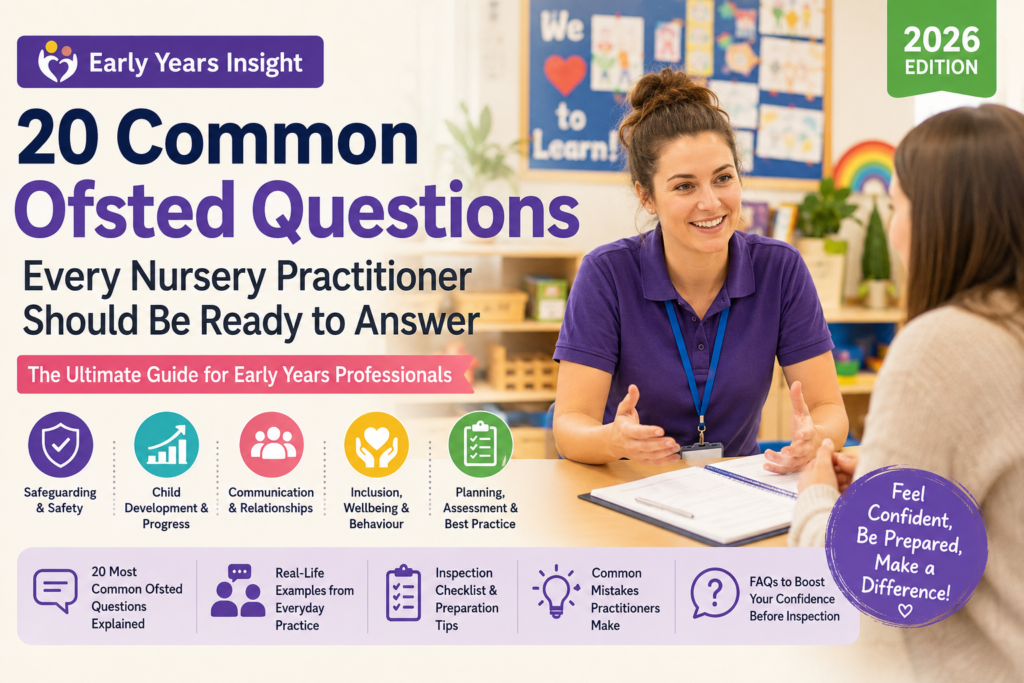
20 Common Ofsted Questions Every Nursery Practitioner Should Be Ready to Answer
Question 1: How Do You Keep Children Safe?
This is one of the first questions an inspector may ask because safeguarding is at the heart of every early years setting. No matter how well children are learning, they cannot thrive unless they are safe and protected.
The inspector is not expecting you to recite your safeguarding policy word for word. Instead, they want to know that you understand your responsibility and that you would act quickly if you had any concerns about a child’s welfare.
A confident answer could be:
“Keeping children safe is everyone’s responsibility. I supervise children closely throughout the day, complete daily risk assessments, follow our safeguarding and child protection policies, and report any concerns immediately to our Designated Safeguarding Lead. I also make sure children feel safe, valued and listened to.”
Real-Life Example
During outdoor play, I noticed that one child kept climbing onto a storage box to reach toys placed on a high shelf. Although the child was enjoying exploring, there was a risk of falling. I immediately moved the resources to a safer height, spoke with my room leader and ensured the area was made safe for all children. Small actions like these help prevent accidents before they happen.
Safeguarding is not only about protecting children from abuse. It also includes creating a safe environment, following correct procedures, maintaining supervision and promoting children’s emotional wellbeing.
Inspector’s Tip
The inspector may ask follow-up questions such as:
- Who is your Designated Safeguarding Lead?
- What would you do if you had concerns about a colleague?
- What would you do if a child made a disclosure?
Always answer honestly and explain the procedures your setting follows.
Keeping Children Safe in Education
Keeping Children Safe in Education
Question 2: How Do You Know Children Are Making Progress?
Every child develops at their own pace, so inspectors want to know how practitioners understand each child’s learning journey.
Your answer should show that you regularly observe children, assess their development and use this information when planning future activities.
A simple answer could be:
“I observe children while they are playing and during everyday routines. I record significant observations, identify their interests and next steps, then plan activities that help them continue developing. I also work closely with parents because they provide valuable information about children’s learning at home.”
Real-Life Example
One child in my key group loved building towers with wooden blocks but became frustrated when they fell down. Through regular observations, I noticed this activity was helping to develop problem-solving skills, perseverance and fine motor control. I introduced different-sized blocks and encouraged the child to predict which blocks would make the tower stronger. Over several weeks, I could clearly see improvements in confidence and persistence.
This example shows that observations are not just paperwork. They help practitioners understand children’s development and provide meaningful learning experiences.
Inspector’s Tip
If possible, talk about a child you know well. Real examples demonstrate that you understand children’s individual learning rather than giving general answers.
Question 3: How Do You Support Children’s Individual Needs?
No two children are the same. They all have different personalities, interests, backgrounds and abilities. Inspectors want to see that practitioners recognise these differences and provide inclusive learning opportunities for every child.
A confident response could be:
“I get to know each child by building positive relationships with them and their families. I observe their interests, understand their stage of development and adapt activities where needed so every child can participate and succeed.”
Real-Life Example
One child in our room enjoyed looking at books but rarely joined group story time because they preferred quieter activities. Instead of insisting they sat through the whole session, we created a cosy book corner where the child could enjoy stories in a smaller group. As their confidence grew, they gradually began joining larger story sessions with their friends.
Small adjustments like this help children feel included while respecting their individual needs.
If a child has SEND, practitioners should explain how they work alongside the SENCO, parents and external professionals to provide appropriate support and monitor progress.
Inspector’s Tip
Avoid saying that every child completes exactly the same activity. Good practice involves adapting experiences so every child can achieve their best.
Question 4: How Do You Promote Communication and Language?
Communication and language are fundamental to children’s learning. Inspectors often observe how practitioners interact with children throughout the day rather than only during planned activities.
A strong answer might be:
“I talk with children throughout the day, listen carefully to what they say, introduce new vocabulary, ask open-ended questions and encourage conversations during play. I also use stories, songs, rhymes and role play to support language development.”
Real-Life Example
While children were playing in the home corner, one child pretended to cook dinner. Instead of simply watching, I joined the play and asked questions like, “What ingredients are you using?” and “Who are you cooking for today?” This encouraged the child to use new words, explain their ideas and develop longer conversations.
These natural interactions often provide the richest learning opportunities.
Inspector’s Tip
Remember that communication happens throughout the day, not only during carpet time or planned activities. Every conversation is a learning opportunity.
Question 5: How Do You Support Positive Behaviour?
Positive behaviour management is about helping children learn appropriate behaviour through guidance, encouragement and strong relationships rather than punishment.
A confident answer could be:
“I build positive relationships with children, praise their achievements, set clear expectations and help them understand their feelings. When conflicts happen, I stay calm, encourage children to talk about what happened and support them in finding solutions.”
Real-Life Example
Two children both wanted to use the same toy truck. Instead of taking the toy away, I encouraged them to explain how they felt and helped them think of different ways to share. After discussing ideas together, they decided to use a timer so each child could have a turn. By supporting the children rather than solving the problem for them, they learned about patience, fairness and cooperation.
Moments like these happen every day in nursery life and provide valuable opportunities to teach important social skills.
Inspector’s Tip
Inspectors are looking for calm, consistent approaches that help children learn self-regulation. They want to see practitioners acting as positive role models and supporting children to understand emotions rather than simply telling them to stop unwanted behaviour.
Looking Ahead
The next section of this guide will cover Questions 6 to 10, including how to involve parents in children’s learning, planning activities, promoting British Values, supporting children with SEND and encouraging independence. These are all common topics discussed during Ofsted inspections and provide further opportunities to demonstrate high-quality early years practice.
Question 6: How Do You Involve Parents in Their Child’s Learning?
Parents and carers are a child’s first and most important educators. Ofsted inspectors want to see that practitioners build strong partnerships with families because children achieve the best outcomes when learning is supported both at home and in the setting.
The inspector is not expecting you to say that every parent attends every meeting or responds to every message. Instead, they want to know how you encourage communication and work together to support each child’s development.
A confident answer could be:
“I believe that parents know their children best, so I work closely with them by sharing observations, discussing children’s progress, listening to their ideas and providing activities they can continue at home. We communicate regularly through conversations, learning journals, newsletters and parents’ meetings.”
Real-Life Example
One child in my key group loved talking about dinosaurs but rarely chose mark-making activities at nursery. After speaking with the child’s parents, I discovered they often visited a local dinosaur park at weekends. We introduced dinosaur-themed writing activities, picture books and role play into the nursery. Because the activities reflected the child’s interests, they became much more enthusiastic about drawing, writing and sharing ideas.
This simple partnership between home and nursery helped create more meaningful learning opportunities.
Inspector’s Tip
Remember that partnership with parents is about communication, respect and working together. Even small daily conversations at drop-off and collection times are valuable.
Question 7: How Do You Plan Activities for Children?
Planning is much more than completing paperwork. Good planning begins by understanding children’s interests, abilities and next steps in learning.
Inspectors want to know that your activities have a purpose and that you are able to adapt them when children’s interests change.
A good answer could be:
“Our planning is based on observations, children’s interests and their stage of development. We provide a balance of adult-led and child-initiated experiences while remaining flexible because children often take learning in exciting new directions.”
Real-Life Example
One morning we planned a painting activity based on different colours. However, several children became fascinated by the rain falling outside the window. Rather than insisting they completed the original activity, we took the learning outdoors wearing waterproof clothing. The children jumped in puddles, collected rainwater, compared the size of puddles and talked about the weather.
Although the activity changed, valuable learning still took place through communication, science, mathematics and physical development.
This demonstrates responsive planning, where practitioners follow children’s curiosity while still supporting the EYFS.
Inspector’s Tip
Inspectors appreciate practitioners who can explain why activities were chosen rather than simply saying, “It was on the planning sheet.”
Question 8: How Do You Promote British Values in Your Setting?
Some practitioners become nervous when they hear the words “British Values”, but promoting them happens naturally every day in early years settings.
The Fundamental British Values include:
- Democracy
- Rule of Law
- Individual Liberty
- Mutual Respect
- Tolerance of Different Faiths and Beliefs
A confident answer could be:
“We promote British Values through our daily routines and interactions. Children are encouraged to make choices, take turns, understand simple rules, respect one another and learn about different cultures and celebrations. These experiences help children become kind, respectful and confident members of their community.”
Real-Life Example
At group time, children voted for the story they wanted to read by raising their hands. Although not everyone chose the same book, they understood that everyone had the opportunity to share their opinion and that the group respected the final decision.
During cultural celebrations, children explored different festivals through food, music, clothing and stories. These activities helped children appreciate similarities and differences between families and communities.
British Values are not separate lessons. They are part of everyday nursery life.
Inspector’s Tip
Avoid memorising definitions. Instead, explain how British Values are promoted naturally through play, routines and positive relationships.
Question 9: How Do You Support Children with SEND?
Every child deserves the opportunity to reach their full potential. Inspectors want to know that practitioners recognise children’s individual needs and provide appropriate support as early as possible.
A confident answer could be:
“I observe children carefully and discuss any concerns with my room leader, SENCO and parents. We work together to plan suitable support, adapt activities where needed and monitor children’s progress. Every child is included and encouraged to participate in nursery life.”
Real-Life Example
One child found busy group activities overwhelming and often preferred playing alone. Instead of expecting the child to join large groups immediately, practitioners introduced smaller group activities with familiar adults. Over time, the child’s confidence increased and they gradually became more comfortable joining larger groups.
Another child benefited from visual picture cards during daily routines. These simple resources helped the child understand what would happen next and reduced anxiety during transitions.
Small adjustments can make a significant difference to children’s confidence and participation.
Inspector’s Tip
Inspectors are looking for inclusive practice. They want to see that every child has opportunities to succeed regardless of their starting point.
Question 10: How Do You Encourage Independence?
Developing independence prepares children for school and for everyday life. Inspectors often observe daily routines because these provide excellent opportunities for children to practise important life skills.
A confident answer could be:
“I encourage children to do as much as possible for themselves while providing support when needed. This includes putting on coats, washing hands, serving food, choosing resources, tidying away toys and solving simple problems independently.”
Real-Life Example
During lunchtime, instead of serving every child’s food, we encouraged children to use child-sized serving spoons to place food onto their own plates. At first, some children needed support, but over time they became much more confident. They learned to judge portion sizes, developed fine motor skills and felt proud of their achievements.
Another example is encouraging children to put on their own coats before outdoor play. Although this sometimes takes a little longer, it helps develop perseverance, confidence and self-help skills.
Giving children time to try for themselves is often more valuable than completing the task quickly for them.
Inspector’s Tip
Independence develops gradually. Inspectors understand that younger children need support, but they want to see practitioners giving children opportunities to learn rather than always doing everything for them.
Everyday Practice Makes the Difference
One thing many practitioners discover after an inspection is that there was no secret formula. Inspectors spent time watching everyday routines, listening to conversations and asking simple questions about practice.
The strongest answers come from practitioners who know their children well, understand why they do things and can explain their daily practice with confidence.
The next section of this guide explores more common Ofsted questions, including safeguarding disclosures, supporting healthy lifestyles, reflective practice, preparing children for school and why professional development is so important in early years education.
Question 11: What Would You Do If a Child Made a Safeguarding Disclosure?
This is one of the most important questions an Ofsted inspector may ask. Safeguarding is everyone’s responsibility, and inspectors want to know that every member of staff understands what to do if a child shares something that makes them concerned about the child’s safety or wellbeing.
A child may not always say directly that something is wrong. Sometimes they may make a comment during play, draw a picture, or say something that causes concern. As practitioners, it is important to stay calm and respond in a way that helps the child feel safe.
A confident answer could be:
“If a child made a disclosure, I would stay calm, listen carefully without interrupting, reassure the child that they have done the right thing by telling me and avoid asking leading questions. I would record exactly what the child said using their own words and report the concern immediately to our Designated Safeguarding Lead (DSL), following our safeguarding policy.”
Real-Life Example
Imagine a child says during role play, “Daddy hit me because I was naughty.”
Although this statement may be upsetting, it is important not to panic or ask lots of questions. Instead, you might calmly respond by saying, “Thank you for telling me.” You would then follow your setting’s safeguarding procedures and report the concern immediately to the DSL.
It is never the practitioner’s role to investigate what happened. That responsibility belongs to the appropriate safeguarding professionals.
Inspector’s Tip
Inspectors may ask additional questions such as:
- What should you record?
- Who would you report the concern to?
- What would you do if the DSL was not available?
- What if your concern involved another member of staff?
Being familiar with your setting’s safeguarding procedures will help you answer confidently.
Question 12: How Do You Promote Healthy Lifestyles?
Helping children develop healthy habits from an early age supports their physical development, emotional wellbeing and lifelong health.
Inspectors often observe snack times, meal times and outdoor play because these provide valuable opportunities to promote healthy choices.
A confident answer could be:
“We encourage healthy eating, provide access to fresh drinking water throughout the day and promote regular physical activity through indoor and outdoor play. We also teach children about hygiene, such as washing their hands before eating and after using the toilet.”
Real-Life Example
During snack time, children are encouraged to pour their own water, choose healthy fruit and talk about why different foods help our bodies grow strong. These simple conversations help children begin to understand healthy eating in a natural and enjoyable way.
Outdoor play also provides daily opportunities for running, climbing, balancing, riding bikes and developing physical confidence.
Healthy lifestyles are supported through everyday routines rather than occasional activities.
Inspector’s Tip
When answering this question, think beyond food. Healthy lifestyles also include physical activity, emotional wellbeing, sleep, hygiene and encouraging children to be active every day.
Question 13: How Do You Reflect on Your Own Practice?
Good practitioners never stop learning. Ofsted values staff who regularly reflect on their practice and look for ways to improve outcomes for children.
Reflection means thinking about what worked well, what could have been improved and what changes can be made in the future.
A confident answer could be:
“I regularly reflect on my practice by discussing activities with colleagues, listening to feedback from parents and managers and attending training courses. I use what I learn to improve my practice and provide better experiences for children.”
Real-Life Example
After completing a messy play activity, I noticed some children lost interest quite quickly. During our team discussion, we realised the activity could be made more engaging by adding natural materials, different tools and opportunities for children to make their own choices.
The following week, the children remained engaged for much longer and demonstrated greater curiosity and creativity.
Reflection helps practitioners improve every day.
Inspector’s Tip
Inspectors appreciate practitioners who can explain something they have changed and why it improved children’s learning.
Question 14: How Do You Prepare Children for School?
School readiness is about much more than recognising letters and numbers. It is about helping children become confident, independent learners who are ready for the next stage of their education.
A confident answer could be:
“We prepare children for school by encouraging independence, communication, confidence, emotional resilience and positive relationships. We support early literacy and mathematics through play while helping children develop the skills they need for everyday routines.”
Real-Life Example
Children are encouraged to hang up their own coats, tidy away resources, manage simple self-care routines, listen during group activities and work cooperatively with others.
These everyday experiences build confidence and independence, which are just as important as early reading and writing skills.
School readiness develops gradually through consistent daily experiences rather than formal lessons.
Inspector’s Tip
Avoid focusing only on academic skills. Explain how your setting supports children’s social, emotional and physical development alongside literacy and mathematics.
Question 15: Why Is Professional Development Important?
Early years practice is always evolving. New research, updated guidance and changes to legislation mean practitioners need to continue learning throughout their careers.
Inspectors may ask about recent training because they want to see that practitioners keep their knowledge up to date.
A confident answer could be:
“Professional development helps me improve my knowledge and confidence. I attend training, read guidance, learn from colleagues and reflect on my practice so I can provide the best possible care and education for children.”
Real-Life Example
After attending safeguarding refresher training, our team reviewed our recording procedures together. We made small improvements to ensure information was recorded more clearly and consistently. This increased everyone’s confidence in following safeguarding procedures.
Continuous learning benefits not only practitioners but also children and families.
Inspector’s Tip
You do not need to attend expensive courses to demonstrate professional development. Reading guidance, participating in team meetings, completing online training and reflecting on everyday practice all contribute to professional growth.
Building Confidence Every Day
Many practitioners worry about saying the “right” thing during an inspection. In reality, inspectors are interested in authentic conversations about your everyday practice. If you understand your role, know the children in your care and can explain why you do what you do, your confidence will naturally grow.
The final part of this guide will cover the remaining Ofsted questions, common mistakes practitioners should avoid, an inspection day checklist, frequently asked questions and practical advice to help you feel fully prepared for your next Ofsted inspection.
Question 16: How Do You Support Children’s Emotional Wellbeing?
Children learn best when they feel safe, secure and valued. Emotional wellbeing is at the heart of everything we do in early years, and Ofsted inspectors want to see that practitioners build positive relationships with every child.
Children experience a wide range of emotions throughout the day. Some may feel excited, while others may feel anxious, frustrated or upset. As practitioners, it is our role to help children understand these feelings and support them in developing emotional resilience.
A confident answer could be:
“I support children’s emotional wellbeing by building positive relationships, listening carefully to their feelings and helping them express their emotions in a safe and respectful way. I provide reassurance, comfort and encouragement while creating an environment where every child feels valued and included.”
Real-Life Example
A child who had recently started nursery became upset every morning when saying goodbye to their parent. Instead of rushing the transition, the key person spent time comforting the child, offering their favourite book and involving them in a familiar activity. After a few weeks, the child began arriving with confidence and settled much more quickly.
This shows how consistency, patience and secure relationships help children feel emotionally safe.
Question 17: How Do You Work as Part of a Team?
High-quality early years practice depends on teamwork. Inspectors want to know that staff communicate effectively, support one another and work together to provide the best possible experiences for children.
A confident answer could be:
“Good teamwork is essential in early years. We communicate throughout the day, share important information about children, support each other during routines and work together to maintain a safe, welcoming learning environment. We also attend staff meetings and training to improve our practice.”
Real-Life Example
During a busy morning, one practitioner noticed that another member of staff was comforting a child who had become upset. Without being asked, other team members adjusted their responsibilities so routines continued smoothly while ensuring the child received the attention they needed.
Strong teamwork helps the whole setting run effectively and ensures children’s needs remain the priority.
Question 18: How Do You Promote Equality, Diversity and Inclusion?
Every child deserves to feel respected, valued and included regardless of their background, culture, religion, language, ability or family circumstances.
Inspectors want to see that equality and inclusion are reflected in everyday practice rather than being limited to occasional celebrations.
A confident answer could be:
“We create an inclusive environment where every child feels welcome and respected. We provide resources that reflect different cultures, encourage children to respect one another and celebrate the diversity within our community. Activities are adapted so that every child can participate and succeed.”
Real-Life Example
Our book area includes stories featuring different families, cultures and abilities. During group discussions, children are encouraged to share their own experiences and learn about others. This helps them develop respect, kindness and an understanding that everyone is unique.
Promoting equality means ensuring every child has the opportunity to thrive.
Question 19: What Would You Do if a Parent Raised a Concern or Complaint?
Good communication with families is an important part of early years practice. Inspectors may ask how practitioners respond when parents have concerns.
A confident answer could be:
“I would listen carefully, remain calm and treat the parent’s concern with respect. If I could not resolve the issue myself, I would follow the setting’s complaints procedure and involve my room leader or manager where appropriate. It is important that parents feel listened to and that concerns are dealt with professionally and confidentially.”
Real-Life Example
A parent was worried because their child had become upset during drop-off. The key person arranged time to discuss the child’s settling-in routine, explained the support being provided and agreed on strategies to help the child feel more secure. Over the following weeks, the child’s confidence improved and the parent felt reassured.
Good communication helps build trust between families and practitioners.
Question 20: Why Do You Enjoy Working in Early Years?
This question gives practitioners the opportunity to show their passion for supporting children.
Inspectors are not looking for a perfect answer. They simply want to understand your motivation and commitment.
A confident answer could be:
“I enjoy working in early years because every day is different. It is rewarding to watch children grow in confidence, develop new skills and achieve milestones. Knowing that I can make a positive difference to a child’s learning and wellbeing makes this career very meaningful.”
Real-Life Example
One of the most rewarding moments in early years is seeing a child achieve something they have been working towards for weeks, whether it is speaking a new word, writing their name, putting on their own coat or making a new friend. These everyday achievements remind us why our role is so important.
Common Mistakes to Avoid During an Ofsted Inspection
Even experienced practitioners can feel nervous during an inspection. Remember that inspectors are interested in your everyday practice, not in perfect answers.
Some common mistakes include:
- Trying to memorise scripted answers instead of speaking naturally.
- Giving very short answers without explaining your practice.
- Forgetting to link activities to children’s learning and development.
- Not being familiar with the setting’s safeguarding procedures.
- Becoming flustered if you do not know an answer.
- Missing opportunities to talk about individual children and their progress.
- Speaking negatively about colleagues or the setting.
- Forgetting that everyday routines provide valuable learning opportunities.
- Not referring to partnership working with parents and other professionals.
- Focusing only on planned activities instead of child-led learning.
If you are unsure about a question, it is perfectly acceptable to pause, think and answer honestly.
Quick Ofsted Preparation Checklist
Before an inspection, ask yourself:
✔ Do I know who the Designated Safeguarding Lead (DSL) is?
✔ Can I explain how I keep children safe?
✔ Do I know my key children’s interests and next steps?
✔ Can I explain how observations support planning?
✔ Am I confident talking about the EYFS?
✔ Can I explain how we work with parents?
✔ Do I know how to support children with SEND?
✔ Can I describe how we promote British Values?
✔ Do I understand our behaviour management approach?
✔ Can I explain how children become independent in our setting?
If you answered “yes” to these questions, you are already well prepared.
Frequently Asked Questions
Do Ofsted inspectors expect perfect answers?
No. Inspectors are looking for genuine understanding of your role and everyday practice, not memorised responses.
Will every practitioner be asked questions?
Not always, but every member of staff should be prepared to talk confidently about their role.
What happens if I do not know an answer?
Be honest. Explain that you would refer to your setting’s policy or ask your manager if you were unsure.
Do inspectors speak to apprentices?
Yes. Apprentices may be asked questions appropriate to their role and level of responsibility.
Is safeguarding always discussed?
Yes. Safeguarding is a key part of every Ofsted inspection.
Final Thoughts
Preparing for an Ofsted inspection is not about trying to remember a list of perfect answers. It is about understanding why you do what you do every day and being able to explain it with confidence.
The strongest practitioners are those who know their children well, build positive relationships with families, work effectively as part of a team and create environments where every child feels safe, valued and supported to learn.
At Early Years Insight, our goal is to provide practical guidance, trusted resources and professional development that support everyone working in the early years sector. Whether you are an apprentice beginning your career or an experienced practitioner preparing for your next inspection, we hope this guide has helped you feel more confident and better prepared.
Remember, every positive interaction you have with a child, every conversation with a parent and every thoughtful learning opportunity you provide contributes to high-quality early years practice. Ofsted inspections may only happen occasionally, but outstanding practice happens every single day.