
Table of Contents
Introduction
Do you work in Early Years? you will already know that observations play an important part of our everyday work. when I started working in Early Years as a practitioner, I thought an observation was all about writing down what a child was doing. After working in Early Years for four years, I have learnt that a good observation is much more than that.
It’s all about getting to know the child their and development.
Through observations we can learn a lot about the children. Their normal play and routines are a good time for observation. At that time, we can clearly see; what they are enjoying’ ‘what they are interested in’ ‘what they can do by themselves’ and which areas they need more support.
For Example, if a child is playing with water, I do not just look at the fact how they are playing with water. I look at what they are doing during the play.
”Are they filling and emptying the container? Are they comparing which container has more or less water and which containers are bigger and smaller? do they use new vocabulary? are they sharing with another child? Are they trying to solve a problem by themselves?”
These small things can tell us a lot about the child’s learning and development.
I have also noticed that a good observation does not have to be very long or have big explanations. Sometimes a few sentences can tell us much more than a whole page if we have captured and important learning moment.
In this article, I will explain what an EYFS observation is, the different observation methods you can use in Early Years, what makes an observation useful and how to plan a suitable next step using an observation.
I will also share practical examples that you can relate to your own nursery practice.
As an Amazon Associate I earn from qualifying purchases.
What is and EYFS Observation?
An EYFS observation is a record of what a child says, does and experiences during play or everyday routines. The important thing is to record what you actually see and hear not to imagine.
For Example, you could write:
“Emily was painting a picture.”
This will tell us what Emily was doing, but it does not tell us anything about her learning.
we have to make the observation more useful by writing:
“Emily Chose three different colours and mixed blue and yellow together. She looked and the paint and said, ‘Look! It’s green!’ She then tried to mixing another two colours and showed her painting to her friends.”
In this way we have much clear and more information.
We can clearly see that Emily is exploring the colours, trying something for herself, communication her ideas and showing he work to another child.
This is what I look for when I am observing a child.
As practitioner I want to know ‘what child is learning through that play.’ not just what activity they are doing.
A good observation should give us clear information about the child’s learning, developing and their interests.
Why Are EYFS Observations Important?
In Early Years, Observations help us understand children as individuals.
Every child is different and unique.
One child may be very confident when taking adults, while another child may communicate more through actions and gestures.
One child may like messy play, but another child may prefer the construction area or books.
As a practitioner when we take the time to observe children properly, we can understand these differences.
Observations can help us:
- Understand the children’s learning and development
- Identify their interests
- Recognise their strengths
- Notice areas where they may need more support
- Plan suitable experiences
- Think about possible next steps
- Share learning with parents
- Build a better understanding of each child
For me, the biggest benefit is that observations help us get to know the child better.
Different Type of EYFS Observation
In Early Years there are different way to observe children. You do not have to use the same method for every child or every situation and it all depends on what you want to find out.
Here are five observation methods that we use in Early Years.
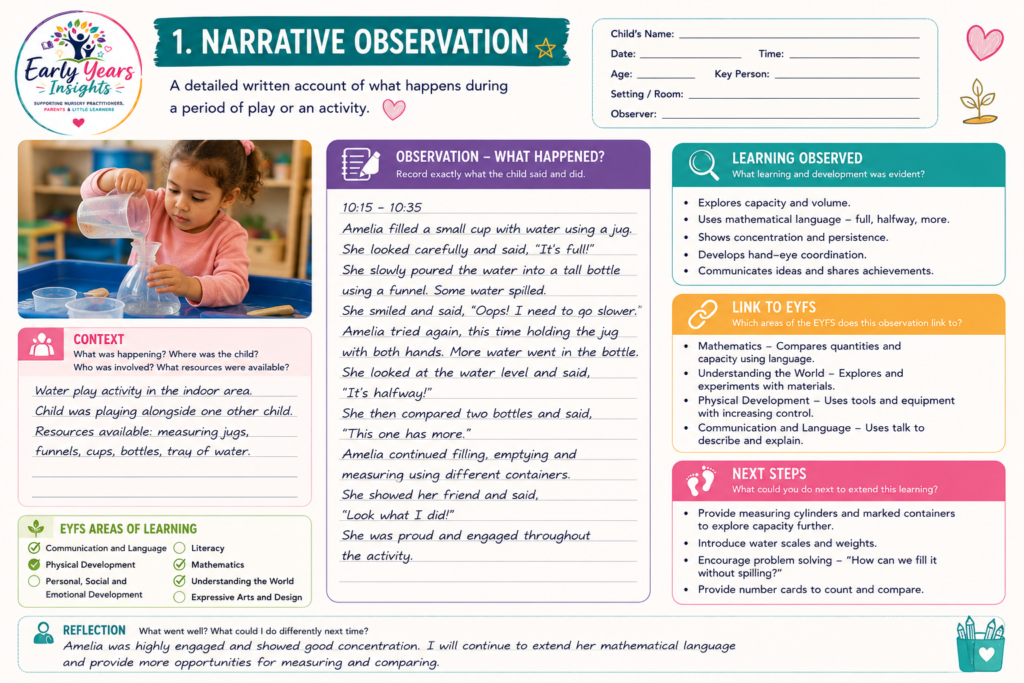
1. Narrative Observation
A narrative observation is a detailed record of what happens during a period of play or learning. You record what the child does and how the child interact with other people. This can be useful when you want to understand something in more detail. For example, you may want to see how a child plays with others, how they communicate or how they solve a problem.
When could you use a narrative observation?
You could use it when you want to:
- Understand a child’s learning in more detail
- Look at how they interact with others
- Identify a suitable next step
- Understand how a child approaches a problem
- Look at development over time
Example
My Advice
Do not make a narrative observation very long just because it is called a narrative observation. Write the information that is useful. If you have captured the important learning, you do not need to add lots of extra sentences.
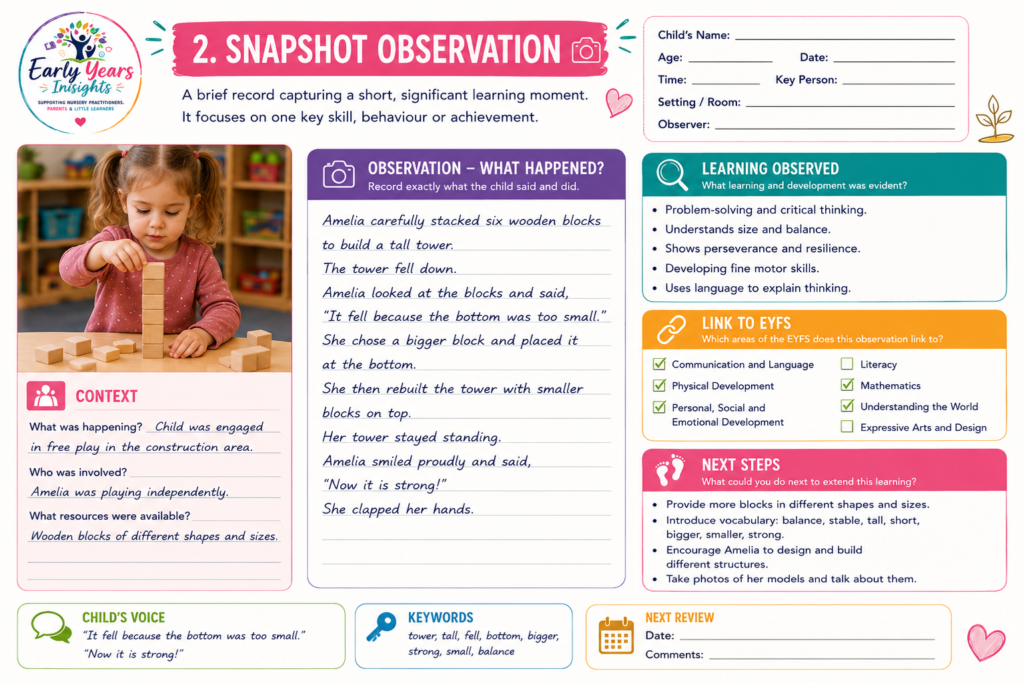
2. Snapshot Observation
A Snapshot observation is a short record of an important learning moment. This can be useful in a busy nursery because children can suddenly show us something new at any time.
For Example, you may see a child who normally struggles to complete a puzzle suddenly complete it independently. For this you don’t need to write a long observation. You can record what happened, what the child said and did at that time. This will tells you about their learning.
Snapshot observation can be useful for recording
- New achievement
- Milestones
- New interests
- important learning moments
It can also reduce unnecessary paperwork and time saving because you can record only meaningful moments without a long observation.
Example
Best used for
- Capturing achievements
- Recording milestones
- Collecting evidence for learning journals
Advantages
- Quick to complete.
- Easy to use throughout the day.
- Captures spontaneous learning.
- Requires very little paperwork.
Time Sample Observation
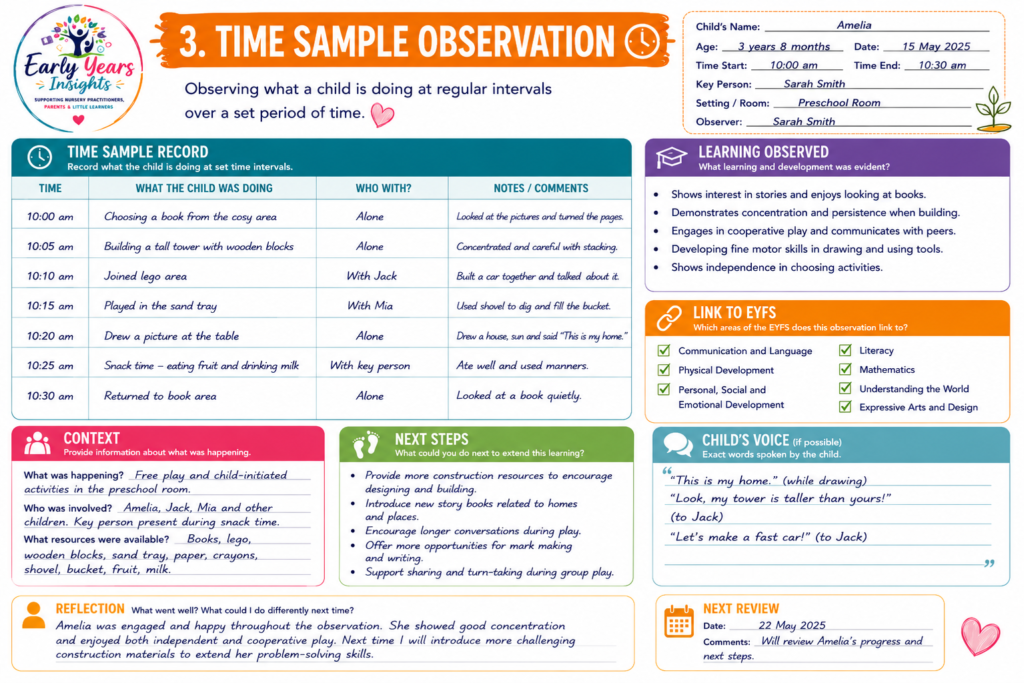
A time sample observation means observing a child at regular times.
For example, you choose a child and observe that child every 5 minutes for thirty minutes and record what that child is doing. This observation will help you to notice patterns of that child.
Through this observation you can identify where the child spends more time and when the child more engaged and when the child moves quickly from the activity.
Time sampling observations can be useful for looking at:
- behaviour
- concentration
- routines
- engagement
- play preferences
Example
Best used for
- Monitoring behaviour
- Measuring concentration
- Identifying play preferences
- Understanding daily routines
Advantages
- Shows behaviour over time.
- Identifies patterns.
- Provides objective evidence.
- Useful for behaviour monitoring.
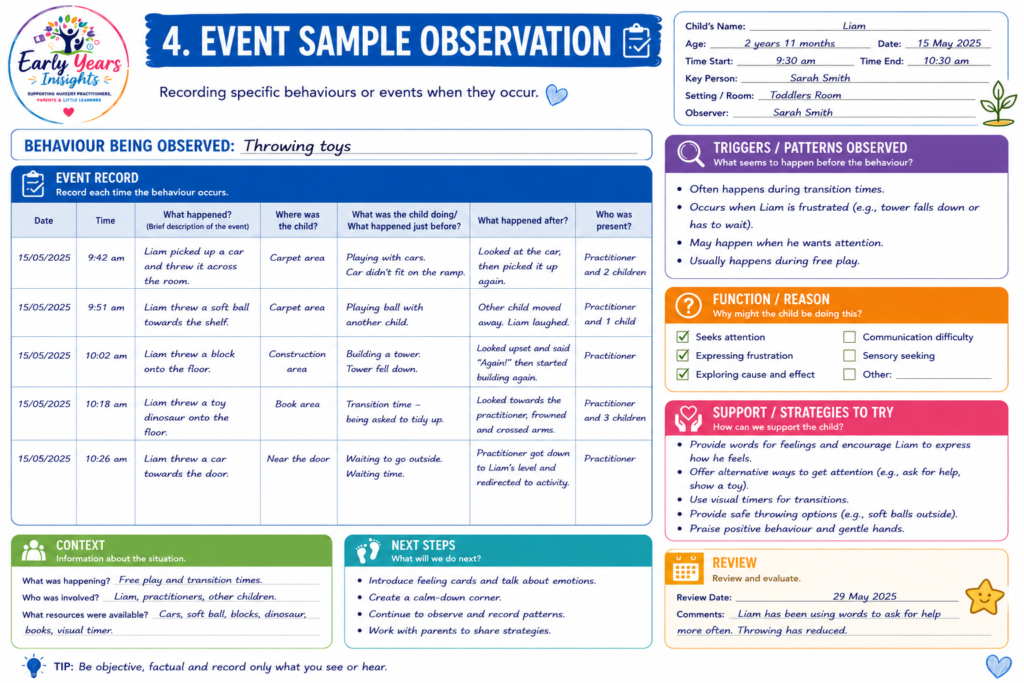
04. Event Sample Observation
An event sample observation focuses on a particular behaviour or event.
For example, As a practitioner, you might want to understand why a particular child keeps throwing toys.
Instead of simply writing the observation:
“The child threw the toys most of the time”
You can look at what happened before the behaviour, what the child did and what happened afterwards. You might notice that the child throws toys when another child takes a toy from them
Or perhaps it happens when the child cannot explain what they want
Or maybe it happens when they are tired.
This information can help practitioners understand the situation better.
Event sampling observations can be useful when looking at:
- repeated behaviour
- Possible triggers
- behaviour support
- patterns over time
Example
Behaviour being observed: Throwing toys
Best used for
- Understanding challenging behaviour
- Identifying triggers
- Behaviour support planning
- Monitoring progress
Advantages
- Helps identify patterns.
- Supports behaviour management.
- Provides evidence for support plans.
- Encourages consistent recording.
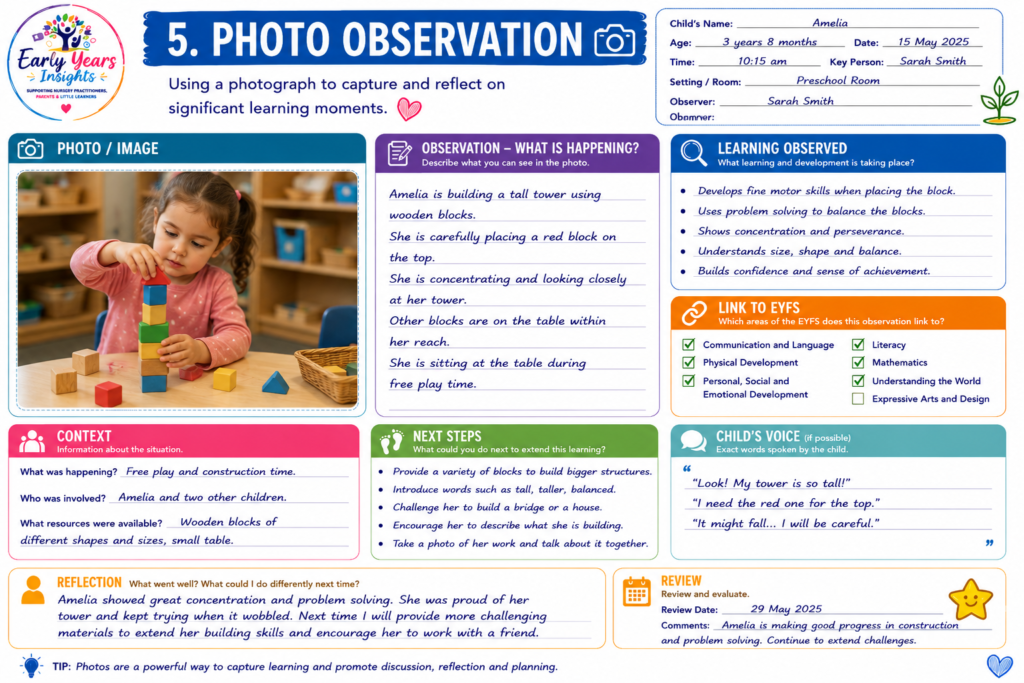
05. Photo Observation
A photo observation uses a photograph together with written information about the child’s learning. Photographs can be useful because they show us what the child was doing.
For example, you may have a photograph of a child building a tower using blocks or taking part in an outdoor activity. But I would not use the photograph on its own.
The photograph should support the written observation. practitioners still need to explain what the child was learning.
Example
Best used for
- Learning journeys
- Parent communication
- Displaying children’s achievements
- Recording practical activities
Advantages
- Provides visual evidence.
- Engages parents.
- Celebrates children’s achievements.
- Supports reflective practice.
Which Observation Method Should You Choose?
In my experience there in no single observation method the works for every situation. This is something that i have learnt from working in Early Years. Sometime quick observation is enough. but other time we need more information about the child.
For example,
If a child suddenly achieve something new – snapshot observation may be sutable.
If I want to understand a child showing particular behaviour – An event sample observation can useful.
If I want to understand how a child learns during a longer period of play – narrative observation may be better.
In child care observation the most important thing is to choose the method because its help us to understand the child.
Remember, do not use the method just because you have used it. Using different method can give you more balanced picture of the child’s learning and development.
What Makes a Good EYFS Observation?
For me, a good observation should answer a simple question:
What did I actually learn about this child from watching them?
A good observation should be:
- Accurate
- Based on what you see and hear
- Focused on learning and development
- Linked to the EYFS when appropriate
- Include the child’s own words where possible
- Useful for planning
- Clear and not unnecessarily long
As a practitioner, we should also avoid guessing what a child is thinking.
For example, instead of:
“Nick was very proud of his tower”
You could write:
“Nick smiled, clapped his hands and said, ‘I made it!'”
This will tell us what you actually saw and heard.
How I Write an EYFS Observation
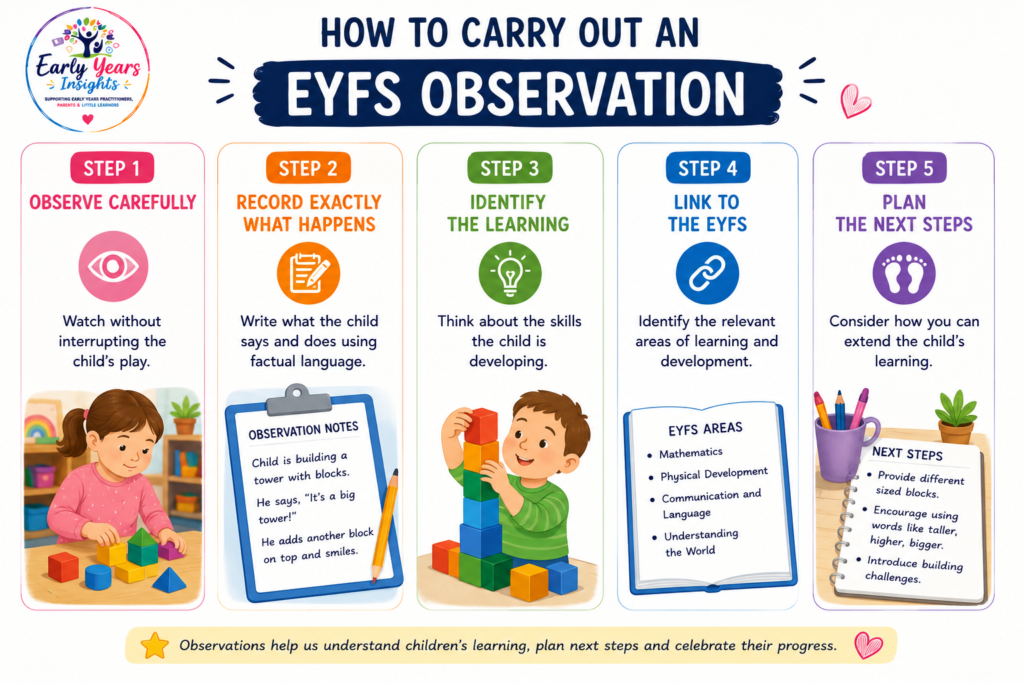
When I am writing an observation, I usually think about a few simple questions.
- What did the child do?
- What did the child say?
- How did the child respond?
- What does this tell me about their learning?
- What are they interested in?
- What could I offer them next?
These questions help me keep the observation focused. I do not need to write everything that happened. I only need to include the information that helps me understand the child.
Real EYFS Observation Example 1 – Water Play
What I Observed
Hari, aged 3 years and 2 months, was playing with different containers during water play. He filled one container and poured the water into another.
He said:
“This one is full but this one need more.”
He carefully poured the water without spilling it.
What Did I Notice?
Hari was comparing quantities.
He was using mathematical language and developing his hand control while pouring the water.
Learning I Identified:
- Mathematical thinking
- Problem-solving
- Fine motor skills
- Communication and language
What could I do next?
I could provide measuring jugs, funnels and different-sized containers.
I could also introduce words such as:
Full, Empty, More, Less and Equal.
This gives Hari more opportunities to explore capacity through his own play.
Real EYFS Observation Example 2- Block Play
What I Observed
Nora was building a tower with wooden blocks.
Her tower fell down.
Instead of giving up, she laughed and said:
“I’ll make it stronger”
She then used langer blocks at the bottom and smaller blocks at the top.
What did I notice?
Nora changed her approach when her first tower fell. She tried again and thought about how she could make the tower stronger.
Learning I Identified
- Problem-solving
- Resilience
- Critical thinking
- Physical development
What could I do next?
I could provide different construction materials and ask Nora to think about which materials might make the strongest stucture.
I could also encourage her to explain why she chose particular blocks.
Real EYFS Observation Example 3 – Role Play
What I observed
Child Leo was playing doctors with another child. He used a toy stethoscope and asked:
“Where dose it hurt?”
He then wrote some pretend notes before giving medicine to his patient.
What did I notice?
Leo was using language during imaginative play. He was also using his imagination and showing an understanding of the role he was pretending to be.
Learning I identified
- Communication and language
- Imaginative play
- Early literacy
- Personal, social and emotional development.
What could I do next?
I could add clipboards, appointment books, pens and simple medical vocabulary to the role-play area. This would give Leo more opportunities to develop his language and early writing.
Real EYFS Observation Example 4 – Outdoor Play
Nina balanced across stepping stones without support. When she reached the end, she smiled and said to another child
“You can do it”
She then waited for her friend.
What did I noticed?
Nina was developing her physical skills. She was also encouraging another child.
Learning I identified
- Gross motor development
- Confidence
- Social skills
- Emotional development.
What could I do next?
I could add balance beams and an obstacle course with different levels of challenge.
This would give Nina more opportunities to develop her balance and physical confidence.
Real EYFS Observation Example 5- Story Time
What I observed?
Nick listened carefully to a story. He predicted what he thought might happen next and answered questions using full sentences.
He also connected part of the story to something that had happened in his own life.
What I notice?
Nick was listening carefully and using this own experiences to help him understand the story.
Learning I identified
- Listening and attention
- Communication
- Literacy
- Critical thinking.
What could I do next?
I could provide puppets and story props so Nick can retell familiar stories in his own words. This can give him more opportunities to develop his language and understanding of stories.
Common Mistakes When Writing Observations
When the nursery is busy, it is easy to make observations too quickly. Here are some common mistakes I would try to avoid.
Only writing about the activity
For example:
“Sara played with play dough.”
This tells us the activity, but it does not tell us what Sara was learning.
Think about what she actually did.
Did she roll the play dough?
Did she use her fingers to make small shapes?
Did she talk about what she was making?
Did she share the resources?
These details can make the observation more useful.
Writing Too Much
A long observation is not always a good observation.
Sometimes we can write a whole page but still not clearly explain what the child learnt.
I would rather write a short observation that tells me something more useful than a long observation full of unnecessary information.
Writing Your Opinion
Try not to write you think the child is feeling unless you have evidence.
Instead of:
“Jack was very happy”
Write what you actually saw.
For example:
“Jack smiled, clapped his hands and said, ‘I did it'”
This gives us evidence.
Forgetting the child’s own words
If a child says something important, include their exact words where possible. Sometimes a child’s words give us very useful information about their thinking.
Forgetting the next step
After writing an observation, ask yourself:
What can I offer this child next?
The next step does not need to be complicated. It could simply be providing more opportunities for the child to practise something they are already interested in.
Writing Meaningful Next Steps
I think next steps are one of the most important parts of an observation. A next step should come from what you have seen.
For example, writing:
“Practise counting”
does not tell us very much.
Instead, you could write:
“Provide opportunities for Mia to count natural objects during outdoor play and compare quantities using words such as more, fewer and equal.”
Now we know what the practitioner could actually provide.
A good next step should:
- Build on the child’s interests
- Be realistic
- Be achievable
- Extend the child’s learning
- Encourage curiosity
- Support their development.
Do You Need to Plan a New Activity for Every Observation?
Not Always.
This is something I have learnt through my own Early Years practice. Sometimes the next step is simply to continue supporting the child’s existing interest.
For example: if a child enjoys building towers, I do not need to create a completely new activity.
I could add different blocks.
I could provide boxes or tubes.
I could show photographs of different buildings.
I could ask:
“What do you think will happen if we put another block on top?”
This can extend the child’s learning without taking them away from what they already enjoy.
Observing Children During Everyday Play
Some of the best learning moments happen during normal nursery routines. We do not always need to create a special activity to get an observation.
A child may show us something important while:
- Eating snack
- Getting ready to go outside
- Playing with friends
- Building with blocks
- Washing their hands
- Looking at a book
- Playing in the garden
- Helping to tidy up.
For example, a child who normally needs help putting on their coat may suddenly try to do it independently.
This is worth noticing.
Another child may help a friend who is struggling with a puzzle.
That could show social development and empathy.
Another child may start counting objects during tidy-up time.
That could give us useful mathematical information.
This is why I believe practitioners need to watch children during their normal everyday experiences, not only during planned activities.
Working With Parents
Parents know their children very well. They may tell us about something their child has started doing at home.
For example, a parent might say:
“She has started counting the stairs at home.”
That information could help us notice whether the child shows the same interest at nursery.
Parents can also share photographs, comments or achievements from home, depending on the setting’s approach.
When we share information with parents, we can build a fuller picture of the child’s learning.
I think observations work best when they are part of a partnership between practitioners and families.
Using Photographs in Observation
Photographs can be useful, but they should not become the whole observation. A photograph can show us what happened.
The written observation should explain the learning.
For example, a photograph may show a child building a tower.
But we still need to know:
- Did they count the blocks?
- Did they solve a problem?
- Did they work with another child?
- Did they use a new language?
- Did they change their plan when the tower fell?
The photograph supports the observation.
It does not replace it.
Always follow your setting’s safeguarding, privacy and consent procedures when taking or sharing photographs.
How Long Should EYFS Observation Be?
There is no fixed length. An observation should contain enough information to show meaningful learning without unnecessary details.
Sometimes a few sentences are enough.
Sometimes a longer observation is useful.
It depends on what you are trying to understand.
I always think:
Is this information useful?
If it is not helping us understand the child, it may not need to be included.
Do All Observations Need to Link Every Area of Learning?
No.
I would not try to link every observation to every area of learning. Only include the areas that you can genuinely see in the observation.
For example, during water play, you might see mathematical thinking, physical development and communication. You do not need to force a literacy link if there is no evidence of literacy learning.
This makes observations more honest and useful.
Should Every Observation Have a Next Step?
A meaningful next step can be useful because it helps us think about what the chid could experience next. But the next step should come from the observatiion.
For example, if a child is interested in counting during outdoor play, provide more opportunities to count.
If a child is interested in stories, provide puppets and story props.
If a child is developing their balance, provide more physical challenges.
The next step should have a reason behind it. It should not just be added because there is a box on the observation from that needs completing.
My Practical Tips for Nursery Practitioners.
After four years of working in Early Years, these are some of the things I would recommend.
Observe children during normal play
You do not always need to create a special activity.
Listen to children
Their own words can tell you a lot about their learning.
Write what you actually see
Try not to make assumptions.
Keep it simple
You do not need complicated words to write a good observation.
Think about the child
Ask yourself what makes this observation important for this particular child.
Think about the next step
What could you provide that builds on what the child has already shown?
Talk to your colleagues
Another practitioner may have noticed something different.
Work with parents
Parents can give you useful information about learning at home.
My Experience with EYFS Observations
After four years working in Early Years, I have realised that knowing the child makes a big difference when writing observations.
For example, imagine you have a child who normally avoids play. One day, you notice them putting their hands into paint and mixing different colours.
That small moment may be important.
It could show that the child is becoming more confident with something they previously avoided.
Another child may normally prefer playing alone.
Then one day, you notice them asking another child to join their game.
This is also meaningful.
It may show progress in their social and emotional development. These moments can easily be missed if we only look for formal learning activities.
This is why I believe observation is not just about recording what happened.
It is about I know the child and noticing their progress.
If you would like to explore child observation and assessment in more detail, A Practical Guide to Child Observation and Assessment – 3rd Edition is another useful resource for early years practitioners. It can provide further ideas to support effective observation and assessment in practice.
Questions I Ask Myself Before I Finish an Observation
Before I save and share an observation, I ask myself:
What did the child actually do?
What did they say?
What did I notice?
What does this tell me about their learning?
What are they interested in?
What could I offer next?
Have I written facts rather than assumptions?
If I can answer these questions, I know I have useful information to work with.
Frequently Asked Questions
How long should an EYFS observation be?
There is no fixed length. It should include enough information to show meaningful learning without unnecessary details.
Do all observations need to link to every area of learning?
No. Only link the observation to the areas of learning that are genuinely demonstrated.
Should every observation include a next step?
A meaningful next step can help practitioners plan future learning opportunities. The next step should be based on what you observed
Do observations need to be very detailed?
No. A useful observation does not have to be long. The important thing is that it gives a clear picture of the child’s learning.
Can I use photographs?
Yes, photographs can support an observation, but they should not replace the written information. Always follow your setting’s policies about safeguarding, privacy and consent.
Do I need to observe every child every day?
The important thing is to know the children well and understand their learning and development. Your setting’s approach will determine how observations and assessment are recorded.
Final Thoughts
For me, a good EYFS observation is not about writing the longest paregraph.
It is about noticing something meaningful about a child.
It could be the first time a child uses a new word.
It could be a child solving a problem.
It could be a child sharing with a friend.
It could be a child trying something they were not confident enough to do before.
It could even be a very small change that another person might not notice.
After four years of working in Early Years, I have learnt that these small moments are important.
We do not need to make observations complicated.
Watch the child.
Listen to the child.
write what you actually see and hear.
Think about what the child is learning.
Then think about what you can offer next.
The best observation is not necessarily the longest one.
It is the one that helps you understand the child better and gives you a clear idea of how you can support their next step.
Official Resources
For the latest statutory requirements, readers can check the EYFS Statutory Framework.
Practitioners can also use Development Matters to support their understanding of children’s learning and development.