
Table of Contents
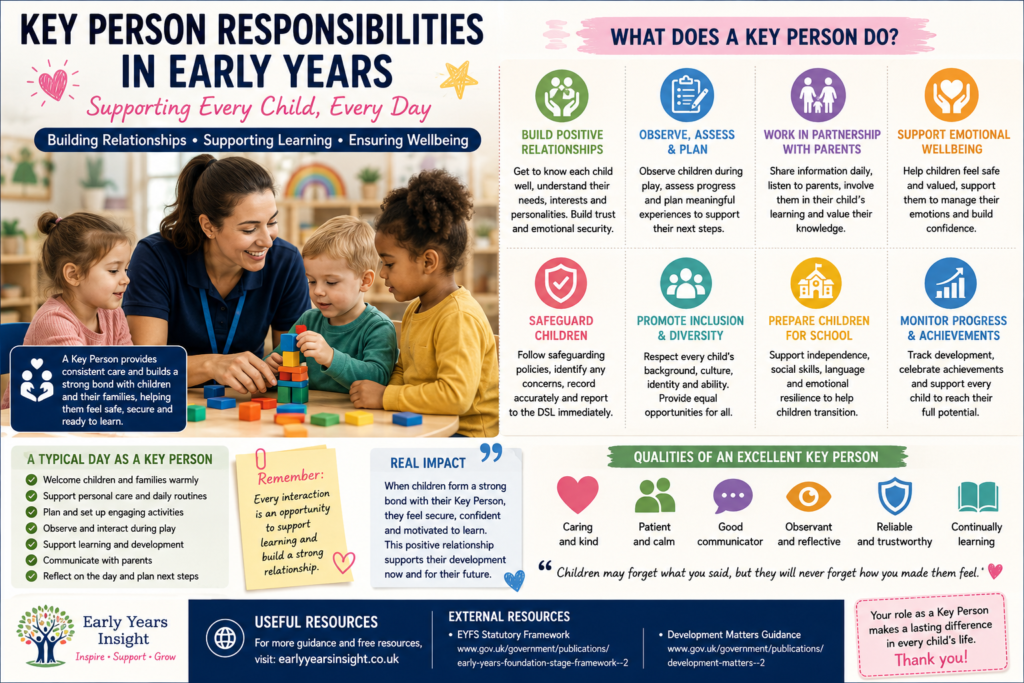
Key Person Responsibilities in Early Years are essential for supporting children’s learning, development, wellbeing, and safeguarding. A Key Person builds strong relationships with children and families while ensuring every child receives individual care and support in line with the EYFS framework. Every child deserves to feel safe, valued, and supported when they attend a nursery, preschool, or childminding setting. One of the most important ways this happens is through the Key Person approach. A Key Person provides consistent care, builds trusting relationships, and supports each child’s learning and development from the moment they join the setting.
The role goes far beyond supervising children during the day. A Key Person gets to know each child’s personality, interests, strengths, and individual needs. They work closely with families, complete observations, plan learning experiences, and help children feel confident enough to explore, play, and develop new skills.
Whether you are new to early years or an experienced practitioner looking to refresh your knowledge, this guide explains everything you need to know about being an effective Key Person. It also includes practical examples from everyday nursery life, links to official guidance, and useful resources to support your professional practice.
If you would like to learn more about how children’s learning is assessed, you may also find our guide on How to Create High-Quality EYFS Observations (With Real Examples) helpful:
https://earlyyearsinsight.co.uk/how-to-create-high-quality-eyfs-observations-with-real-examples/
What Is a Key Person?
A Key Person is an early years practitioner who takes special responsibility for a small group of children within a nursery, preschool, or childminding setting. They provide consistent care and build a secure relationship with each child and their family.
Having one familiar adult helps children settle into the setting, develop confidence, and feel emotionally secure. Young children often feel anxious when they first leave their parents or carers. Knowing that one trusted practitioner will greet them each day, comfort them when needed, and celebrate their achievements helps them feel safe and ready to learn.
The Key Person also becomes the main point of contact for parents. They share information about the child’s day, discuss progress, answer questions, and work together with families to support learning both at home and in the setting.
What Does the EYFS Say About the Key Person?
The Early Years Foundation Stage (EYFS) Statutory Framework requires all early years providers to assign a Key Person for every child.
According to the EYFS, the Key Person helps ensure that every child’s care is tailored to meet their individual needs. They also support parents in helping their child become familiar with the setting and build positive relationships with families.
You can read the official guidance here:
EYFS Statutory Framework
https://www.gov.uk/government/publications/early-years-foundation-stage-framework–2
To support the EYFS in practice, practitioners should also use Development Matters, which provides practical guidance on children’s learning and development.
Development Matters
https://www.gov.uk/government/publications/development-matters–2
Understanding these documents helps practitioners provide high-quality care while meeting statutory requirements.
Why Is the Key Person Role So Important?
Children learn best when they feel emotionally secure. Before they can confidently explore their environment, build friendships, or develop new skills, they need to know there is someone they trust.
A caring Key Person provides this sense of security.
When children have a strong attachment to a familiar adult, they are more likely to:
- Feel confident entering the setting.
- Build positive relationships with others.
- Develop communication skills.
- Become more independent.
- Explore new learning experiences.
- Manage their emotions.
- Develop resilience.
- Enjoy coming to nursery.
Research has consistently shown that secure relationships during the early years have a positive impact on children’s social, emotional, and cognitive development.
A Real Nursery Experience
During my time working in an early years setting, a little boy who had recently turned two found it extremely difficult to separate from his father each morning. As soon as his dad tried to leave, he became upset and cried for a long time.
Instead of trying to distract him immediately, I developed a simple routine. Every morning we would walk together to the book corner, choose a favourite story, and spend a few minutes looking through the pictures before joining the other children.
Within a few weeks, the tears became shorter, and eventually he began waving goodbye with a smile. Later, he confidently joined his friends in construction play without needing reassurance.
This experience reminded me that children do not always need complicated interventions. They often need consistency, patience, and one trusted adult who understands their feelings.
Building Secure Relationships
The relationship between a Key Person and a child is based on trust.
Children should know that their Key Person will:
- Listen to them.
- Comfort them when they are upset.
- Celebrate their achievements.
- Encourage independence.
- Respect their ideas.
- Help them solve problems.
- Keep them safe.
Simple daily interactions such as smiling, making eye contact, talking during mealtimes, reading stories together, and joining children in play all help strengthen these relationships.
Children who feel emotionally secure are more willing to take part in activities, communicate with others, and try new experiences.
Qualities of an Excellent Key Person
Being a Key Person is about much more than completing paperwork or supervising activities. It requires genuine care, patience, and professionalism.
An effective Key Person is:
- Kind and approachable.
- Patient with every child.
- A good listener.
- Calm under pressure.
- Observant.
- Organised.
- Respectful.
- Trustworthy.
- A positive role model.
- Committed to safeguarding children.
Great practitioners also reflect on their own practice. They regularly think about what went well, what could be improved, and how they can continue developing their professional knowledge.
Supporting Every Child as an Individual
No two children are exactly the same.
Some children settle quickly, while others need more time. Some enjoy messy play, while others prefer construction toys or quiet reading areas. Every child develops at their own pace and has unique interests, strengths, and ways of learning.
A Key Person takes time to understand these differences rather than expecting every child to follow the same routine in the same way.
For example, if a child loves dinosaurs, this interest can be used to encourage counting, mark making, storytelling, and outdoor exploration. Following children’s interests helps make learning meaningful and enjoyable.
This personalised approach is a key principle of the EYFS and supports positive outcomes for all children.
Continue Learning with Early Years Insight
If you’re looking to strengthen your knowledge, explore these helpful resources on Early Years Insight:
- How to Create High-Quality EYFS Observations (With Real Examples)
https://earlyyearsinsight.co.uk/how-to-create-high-quality-eyfs-observations-with-real-examples/ - Free EYFS Resources
https://earlyyearsinsight.co.uk/free-resources/ - Autism Awareness in Early Years
https://earlyyearsinsight.co.uk/autism-awareness-in-early-years/
Daily Key Person Responsibilities in Early Years
Being a Key Person involves much more than supervising children throughout the day. Every interaction provides an opportunity to support children’s learning, wellbeing, and development. From welcoming children in the morning to sharing information with parents at the end of the day, the Key Person plays an important role in creating a positive and nurturing environment.
Although responsibilities may vary slightly between settings, the aim remains the same—to ensure that every child feels safe, supported, and encouraged to reach their full potential.
Welcoming Children Each Morning
The day often begins with greeting children and their families. A warm welcome helps children feel secure and reassures parents that their child is in safe hands.
For some children, arriving at nursery is exciting. Others may feel nervous, especially if they are new to the setting or have experienced changes at home. Taking a few moments to greet each child by name, smile, and show genuine interest can make a big difference to how they settle.
Real Nursery Experience
A three-year-old girl in our setting often arrived holding tightly onto her mother’s hand and refused to come inside. Instead of encouraging her to join the group immediately, I invited her to help me water the plants in the outdoor area. This simple routine became something she looked forward to every morning. Within a few weeks, she confidently entered the nursery without becoming upset.
This experience reminded me that every child settles differently. Understanding their interests and creating predictable routines helps children develop confidence over time.
Supporting Children’s Personal Care
Daily care routines are an important part of the Key Person role. These moments provide opportunities to build trusting relationships while encouraging children to become more independent.
Personal care may include:
- Supporting hand washing
- Encouraging good hygiene
- Helping with toileting
- Supporting children during meal and snack times
- Supervising rest or sleep routines
- Encouraging children to dress themselves
Rather than rushing through these routines, practitioners should use them as valuable learning opportunities. Talking to children during hand washing or encouraging them to put on their own coat helps develop communication skills and independence.
Creating a Safe and Stimulating Environment
Children learn best when they feel safe and are surrounded by interesting opportunities to explore.
A Key Person helps prepare an environment that encourages curiosity by providing activities based on children’s interests and developmental stages.
For example, if several children enjoy building with blocks, practitioners may introduce photographs of famous buildings, measuring tapes, or construction role-play resources to extend learning.
The environment should also promote independence by ensuring children can access resources safely and make their own choices during play.
Observing Children’s Learning
Observation is one of the most valuable responsibilities of a Key Person.
Rather than simply watching children, practitioners observe carefully to understand how children learn, what interests them, and where additional support may be needed.
Observations might include:
- New vocabulary children use
- Physical achievements
- Social interactions
- Problem-solving skills
- Creative play
- Confidence levels
- Communication with adults and peers
These observations help practitioners understand each child’s progress and identify their next steps in learning.
For more guidance on writing meaningful observations, read our article:
How to Create High-Quality EYFS Observations (With Real Examples)
Observation in Practice
Real Nursery Example
One afternoon I noticed a child repeatedly filling and emptying containers in the water tray. Instead of simply recording that the child enjoyed water play, I observed more closely.
The child counted aloud while pouring water into different-sized containers and compared which one was “full” and which one was “empty.” This showed emerging mathematical understanding, language development, and problem-solving skills.
The following week I extended the activity by adding measuring jugs, funnels, and numbered containers. The child’s interest continued, and new learning naturally developed through play.
This experience demonstrated how careful observations can lead to meaningful planning rather than simply recording what happened.
Planning for Individual Learning
Observation should always lead to planning.
Rather than planning the same activity for every child, effective Key Persons consider each child’s interests, strengths, and next steps.
For example:
A child interested in dinosaurs might enjoy:
- Counting dinosaur figures
- Dinosaur story books
- Fossil exploration
- Mark making dinosaur footprints
- Outdoor dinosaur hunts
Following children’s interests makes learning more enjoyable and supports better engagement.
Planning should remain flexible because children often take learning in unexpected directions.
Encouraging Communication and Language
Language develops through everyday conversations.
Throughout the day, Key Persons should:
- Ask open-ended questions.
- Introduce new vocabulary.
- Read stories.
- Sing songs and rhymes.
- Listen carefully.
- Give children time to respond.
- Encourage conversations between children.
Simple interactions such as discussing the weather during outdoor play or talking about ingredients while baking can significantly support language development.
Promoting Positive Behaviour
Children are still learning how to understand and manage their emotions.
A Key Person supports positive behaviour by:
- Remaining calm.
- Setting clear expectations.
- Praising positive choices.
- Helping children solve disagreements.
- Modelling respectful behaviour.
- Encouraging kindness and sharing.
Real Nursery Experience
Two children wanted to play with the same toy truck. Instead of deciding who should have it, I encouraged them to talk about how they could solve the problem together. After discussing different ideas, they decided to take turns using a timer.
Although this took longer than simply giving the toy to one child, it helped them develop important social skills, patience, and problem-solving abilities.
Encouraging Independence
Developing independence is an important part of preparing children for school.
Throughout the day, practitioners encourage children to:
- Wash their own hands.
- Pour drinks.
- Choose activities independently.
- Put away resources.
- Dress themselves.
- Make simple decisions.
Although it may take children longer to complete tasks independently, allowing them time builds confidence and resilience.
Monitoring Children’s Progress
The Key Person regularly reviews each child’s development to ensure they continue making progress.
Monitoring progress helps practitioners identify:
- Areas of strength.
- Interests.
- Next learning steps.
- Any concerns requiring additional support.
If concerns arise, the Key Person works closely with parents and, where appropriate, the setting’s SENCO or other professionals.
Early identification allows children to receive support as soon as possible.
Reflecting on Practice
Outstanding practitioners continually reflect on their work.
At the end of each day, many Key Persons ask themselves questions such as:
- Did every child feel included today?
- What interested the children most?
- Which activities worked well?
- What could I improve tomorrow?
- Did I spend enough quality time with each of my key children?
Reflection helps practitioners improve their practice and provide better experiences for children.
Supporting Professional Development
Being a Key Person involves continuous learning.
Practitioners should regularly update their knowledge by attending training, reading current guidance, and reflecting on changes within the EYFS.
You may also find these resources helpful:
- Understanding the EYFS Framework
https://earlyyearsinsight.co.uk/understanding-the-eyfs-framework/ - Autism Awareness in Early Years
https://earlyyearsinsight.co.uk/autism-awareness-in-early-years/ - Free EYFS Resources
https://earlyyearsinsight.co.uk/free-resources/
Official Guidance
For further information about observation, assessment, and supporting children’s development, refer to the official government guidance:
Development Matters
https://www.gov.uk/government/publications/development-matters–2
Key Person Responsibilities When Working with Parents
Parents and carers are a child’s first and most important educators. They know their child better than anyone else, including their personality, routines, interests, and individual needs. A successful Key Person values this knowledge and works closely with families to provide consistent care and learning experiences.
Building positive relationships with parents begins from the very first visit to the setting. Taking time to listen to parents, answer their questions, and understand their child’s routine helps create trust and confidence.
Good communication should continue every day through friendly conversations at drop-off and collection times, learning journals, nursery apps, parent meetings, emails, or newsletters. These opportunities allow practitioners and families to share important information about the child’s wellbeing, development, and achievements.
Real Nursery Experience
A little girl in our preschool loved painting and creative activities at nursery but rarely chose these activities at home. During a conversation, her mother mentioned that she thought her daughter preferred playing with dolls because she never asked to paint.
I shared photographs of her artwork and explained how much she enjoyed experimenting with colours and different materials. The following week her mother told me they had started painting together at home every weekend. The child proudly brought in one of her paintings to show her friends.
This simple conversation strengthened the partnership between home and nursery while encouraging learning beyond the setting.
Communicating Effectively with Families
Good communication is about more than simply sharing information. It involves listening carefully, respecting different family backgrounds, and working together to support the child’s development.
A Key Person should communicate professionally, honestly, and sensitively, particularly when discussing concerns.
Useful information to share with parents includes:
- New achievements
- Children’s interests
- Friendships
- Sleep and eating patterns
- Personal care
- Behaviour
- Next learning steps
- Upcoming events
Parents should always feel welcome to ask questions or share information that may affect their child’s wellbeing.
Supporting Children’s Emotional Wellbeing as a Key Person
A child’s emotional wellbeing affects every aspect of their learning and development.
Children who feel happy, secure, and understood are more willing to explore, communicate, build friendships, and develop confidence.
The Key Person supports emotional wellbeing by:
- Listening carefully.
- Offering reassurance.
- Helping children understand their emotions.
- Creating predictable routines.
- Encouraging positive relationships.
- Celebrating achievements.
- Supporting children through change.
Children experience many transitions during their early years, including starting nursery, moving rooms, welcoming a new sibling, or preparing for school. Having one trusted adult available during these changes provides valuable emotional security.
Safeguarding Responsibilities
Safeguarding is one of the most important responsibilities of every Key Person.
Children have the right to grow up in a safe, secure environment where they are protected from harm, abuse, neglect, and exploitation. Although every member of staff shares responsibility for safeguarding, the Key Person is often in the best position to notice changes because they know their key children so well.
A Key Person should:
- Follow the setting’s safeguarding policy.
- Know who the Designated Safeguarding Lead (DSL) is.
- Recognise possible signs of abuse or neglect.
- Record concerns accurately.
- Report concerns immediately.
- Maintain confidentiality.
- Attend regular safeguarding training.
Practitioners should never investigate concerns themselves or promise to keep safeguarding disclosures secret.
Real Nursery Experience
One little boy who usually enjoyed playing outside suddenly became withdrawn and quiet over several days. He no longer wanted to join group activities and became upset when adults raised their voices, even during normal conversations.
Because I knew him well as his Key Person, I recognised this was unusual behaviour. I carefully recorded my observations and shared them with our Designated Safeguarding Lead following the nursery’s safeguarding procedures.
Although changes in behaviour do not always indicate abuse, recording concerns early and following procedures helps ensure children receive appropriate support whenever needed.
Supporting Children with SEND
Every child develops at their own pace.
Some children require additional support due to Special Educational Needs and Disabilities (SEND). The Key Person plays an important role in identifying possible concerns and ensuring children receive the support they need.
This does not mean diagnosing conditions. Instead, practitioners observe children’s development carefully and discuss concerns with parents and the Special Educational Needs Coordinator (SENCO).
Support may involve working alongside professionals such as:
- Speech and Language Therapists
- Educational Psychologists
- Occupational Therapists
- Physiotherapists
- Health Visitors
Early identification allows interventions to begin sooner, improving outcomes for children.
If you would like to learn more about supporting neurodiverse children, read our guide:
Autism Awareness in Early Years
Promoting Inclusive Practice
An effective Key Person celebrates diversity and ensures every child feels respected and included.
Children come from different cultures, religions, languages, and family backgrounds. Some may have disabilities or additional needs, while others may be learning English as an additional language.
Inclusive practice means adapting activities so every child can participate and experience success.
For example:
- Providing dual-language books.
- Celebrating cultural festivals.
- Offering accessible resources.
- Using visual supports.
- Respecting dietary requirements.
- Encouraging children to value differences.
An inclusive environment helps children develop empathy, respect, and confidence.
Preparing Children for School
One of the Key Person’s responsibilities is helping children become ready for Reception.
School readiness is about much more than recognising letters and numbers. Children also need social, emotional, and practical skills that help them manage everyday routines.
These include:
- Using the toilet independently.
- Washing hands.
- Putting on coats.
- Following simple instructions.
- Taking turns.
- Listening during group activities.
- Managing feelings.
- Speaking confidently.
- Solving simple problems.
Children develop these skills gradually through everyday play and routines rather than formal lessons.
Real Nursery Experience
As one group of preschool children prepared to move to Reception, we noticed that several children were relying heavily on adults to put on their coats.
Instead of helping immediately, practitioners encouraged children to try independently using the “flip trick.” Within a few weeks, nearly every child could put on their own coat confidently.
Although this seemed like a small achievement, it built confidence and prepared children for greater independence at school.
Preparing for an Ofsted Inspection
During an inspection, inspectors often speak directly with practitioners about their key children.
They may ask questions such as:
- How well do you know your key children?
- How do you assess children’s progress?
- How do you plan next steps?
- How do you work with parents?
- How do you promote communication and language?
- How do you support children’s emotional wellbeing?
- What would you do if you had a safeguarding concern?
Outstanding practitioners answer confidently because they genuinely know each child well rather than relying solely on written observations.
Inspectors are interested in seeing how practitioners interact with children during everyday routines, not just the paperwork they produce.
Continuous Professional Development
The early years sector continues to develop as new research and guidance become available.
Excellent Key Persons regularly improve their knowledge through:
- Training courses
- Professional reading
- Team discussions
- Reflective practice
- Online learning
Continuous professional development helps practitioners provide the highest standard of care and education.
You may also find these resources useful:
- Understanding the EYFS Framework
https://earlyyearsinsight.co.uk/understanding-the-eyfs-framework/ - Free EYFS Resources https://earlyyearsinsight.co.uk/free-resources/
Official Guidance
For further reading, refer to the official government guidance:
Early Years Foundation Stage (EYFS) Statutory Framework
Frequently Asked Questions
What is a Key Person in Early Years?
A Key Person is a designated practitioner who develops a secure and positive relationship with a child. They support the child’s learning, development, emotional wellbeing, and work closely with parents or carers to ensure each child’s individual needs are met.
What are the main responsibilities of a Key Person?
A Key Person is responsible for building trusting relationships, carrying out observations and assessments, planning next steps in learning, supporting children’s emotional wellbeing, maintaining communication with parents, and following safeguarding procedures.
Why is the Key Person role important in the EYFS?
The Key Person role is important because it helps children feel safe, secure, and valued. A strong relationship with a trusted adult supports children’s confidence, emotional development, learning, and smooth transitions within the early years setting.
How does a Key Person work with parents?
A Key Person shares information about a child’s progress, discusses learning and development, listens to parents’ concerns, and works in partnership to provide consistent care and support both at home and in the setting.
How does a Key Person support children’s emotional wellbeing?
A Key Person helps children settle into the setting, encourages positive relationships, supports emotional regulation, provides reassurance during difficult moments, and creates a nurturing environment where children feel confident and secure.
What might Ofsted ask about the Key Person role?
Ofsted may ask how practitioners know their key children well, how they monitor progress, how they work with parents, how they identify additional needs, and how they support each child’s learning and development through the EYFS curriculum.