
Table of Contents
Introduction
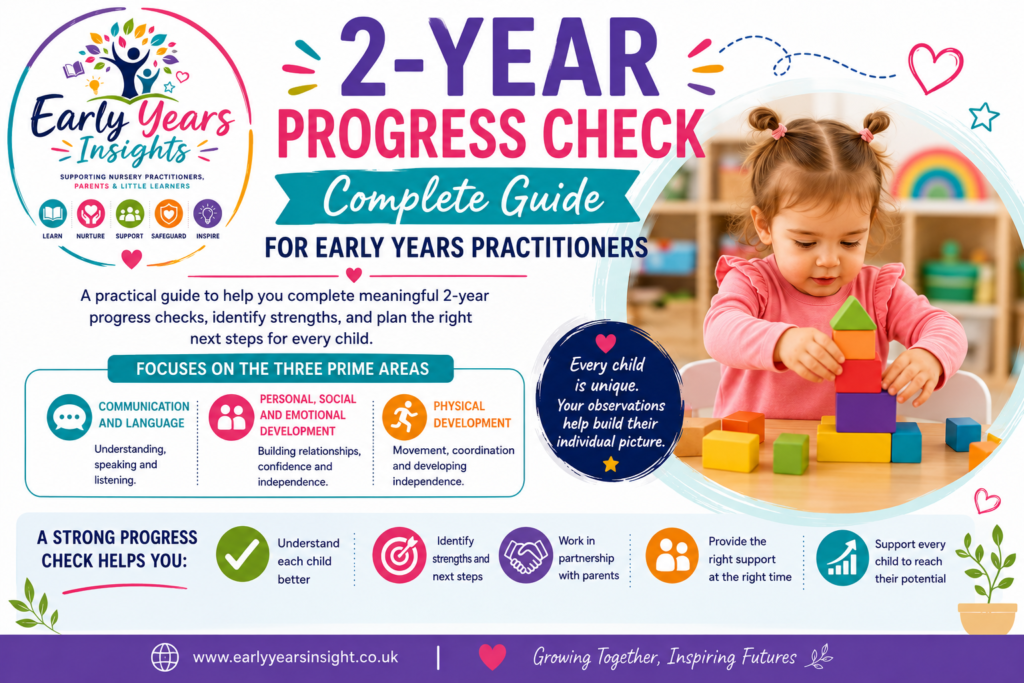
The 2-year progress check is an important part of working with young children in Early Years.
If you work in a nursery, preschool or another Early Years setting, you will know that children develop in different ways, at different times and at different ages. Two children who are the same age may have very different strengths in different ways.
One child may talk a lot and use a good range of vocabulary while playing, but need help with physical activities for example, during garden play or other challenging physical activities. Another child may be very confident with running, jumping and climbing but still be learning how to use words to communicate and having difficulty using new vocabulary. Another child may be very independent but find it difficult to play with other children for example, joining in home corner play or circle time.
All children are unique and individual in their own way. This is why the 2-year progress check should look at the individual child’s development. The 2-year progress check should not be about comparing one child with another. It should not be about filling only the boxes. As a practitioner, it should help you to understand the child better and give a clear picture of the child.
A good progress check tells parents what their child can do, what they enjoy, where they may need more support and what the setting plans to support next, also, what support we are expecting from the parents for their child’s development.
For practitioners, it is also a good time to stop and think about the child.
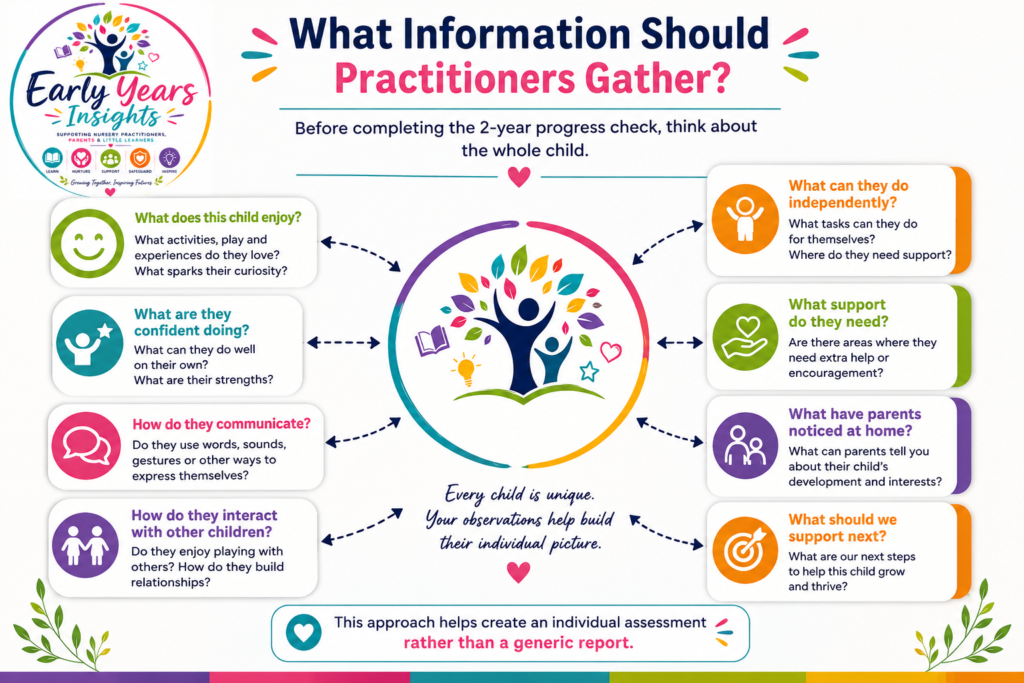
What have I noticed?
What can this child do now?
What are they learning?
What do they enjoy?
How do they communicate?
What helps them?
What should we support next?
This guide explains the 2-year progress check in simple English. It includes practical examples that can help Early Years practitioners write a clear and useful progress check.
As an Early Years practitioner in England, it is really important to follow the current EYFS statutory framework, your setting’s policies and your local guidance.
What is the 2-year progress check in Early Years?
The 2-year progress check is a statutory assessment in the Early Years Foundation Stage. When the child turn 2 or the child is aged between 2 and 3.
Who will do this progress check?
In the UK there are two professionals who do this check,
- Health visitor
- Early Years Practitioner (Key worker of the child)
When a child is aged between 2 and 3, the practitioner( key worker) must review the child’s progress and give the parents or carers a written summary report.
The summary report must cover the three prime areas of the EYFS:
- Communication and language
- Physical development
- Personal, social and emotional development
The Department for Education says the progress check helps practitioners look at a child’s development, recognise strengths, identify concerns or where a child needs additional support and work with parents and other professionals when needed. The guidance supports practitioners but does not replace their professional judgement.
As a practitioner it is very important to understand that the progress check is not a test. You should not try to make a 2-year-old sit down and answer lots of questions. You are observing the child, what the child does during their normal day.
Why is the 2-year progress check important?
Children develop quickly during their early years.
A child may learn a new word one day and start using it many times the next day.
A child who needed help with putting on their coat may suddenly want to try it themselves.
A child who normally plays alone may begin to play alongside another child.
This kind of small change plays a very important role in a child’s day-to-day life.
The progress check gives practitioners and parents a chance to talk about these changes.
It can help us see:
- what the child can already do
- what the child enjoys
- what the child is learning
- what the child is becoming more confident with
- if there are any areas where the child needs more help
- what the nursery can do next
- what parents can do at home
As a practitioner if you observe the child, It is also useful when a child may need extra support.
If a practitioner notices that a child is having difficulty in one area, the progress check can be a good opportunity to discuss this with parents and decide what should happen next.
Is the 2-year progress check compulsory?
Yes.
The EYFS requires practitioners to review a child’s progress when they are aged between 2 and 3 and provide parents or carers with a short-written summary report covering the three prime areas.
The DfE also provides specific guidance to help practitioners complete the check.
The format of the written summary can be decided by the setting, as long as the required information is included.
This means your nursery does not have to use exactly the same form as another nursery.
When should the progress check be completed?
The check should take place when the child is between 2 and 3 years old. The timing should be useful for the child and the practitioner.
For example, if a child has just joined your nursery, you may not know them well enough to write a useful progress check after only a few days.
You need time to see the child in different situations.
You may want to consider:
- How long has the child been at the setting?
- How often do they attend?
- Have they settled?
- Do they have a good relationship with their key person?
- What have the parents told you?
- Do you have information from a previous setting?
- Are any other professionals involved?
The aim is to have enough information to give parents a fair picture of their child’s development.
Do I need lots of observations to do this?
No.
This is something that can worry practitioners when doing the 2-years progress check.
You do not need to create hundreds of observations just because a child is having their 2-year progress check.
The DfE guidance supports practitioners in using their knowledge of the child and professional judgement.
You can use information from the normal nursery day.
For example, you may learn a lot by observing a child:
- playing in the garden
- eating snack
- using play dough
- playing with water
- looking at books
- singing songs
- playing in the home corner
- building with blocks
- getting dressed
- washing their hands
- using the toilet
- playing with another child
- asking an adult for help
These everyday moments can tell you a lot about the child.
An example from everyday play
Imagine a child is playing with play dough.
You may notice whether they are doing these:
- use both hands
- squeeze the dough
- roll it
- use simple words
- ask for a particular colour
- share tools with another child
- stay interested for several minutes
- ask an adult for help
One activity can give you information about more than one area of development.
For example, the child is playing with play dough,
Using the hand – physical development – fine motor skills
Talking with other children – communication and language
Telling imaginative stories – personal and social and emotional development
This is why good assessment does not always need to mean more paperwork.
What should you look at during the check?
The 2-year progress check focuses only on the three prime areas.
Let’s look at each one.
Communication and language
Communication is not only about how many words a child can say.
Children communicate in many different ways.
A child may use:
- words
- sounds
- pointing
- gestures
- facial expressions
- signs
- body movements
- eye contact
- showing an adult an object
Some children may speak a lot.
Some children may use only a few words.
Some children may understand much more than they can say and express.
This is why as a practitioner we need to look at the whole picture.
What can practitioners look for?
The main things practitioners should know about:
- Does the child respond to their name?
- Do they understand simple instructions?
- Can they express to you what they want?
- Do they use words?
- Do they use gestures?
- Are they starting to put words together to make a sentence?
- Do they enjoy songs?
- Do they enjoy stories?
- Do they listen when an adult talks?
- Do they respond to questions?
- Do they communicate with other children?
- How do they communicate when they are upset?
You do not need to ask the child all these questions.
Watch what happens naturally and observe them closely.
Example
Imagine a child wants a cup during pretend play.
They may point to the cup.
They may say “cup”.
They may say “want cup”.
They may take an adult by the hand and show them.
All of these are ways of communicating.
Your assessment should explain what the child actually does.
Weak example
“Child A has good communication skills.”
This does not tell the parent very much.
Better example
“Child A uses familiar words and gestures to tell adults what he wants. He points to resources and is beginning to use two words together. He enjoys familiar songs and often joins in with repeated words.”
This is much clearer.
How can we support communication?
You can support language during normal activities.
For example:
During snack time, talk about the food.
“Apple.”
“Red apple.”
“Would you like more apple?”
During outdoor play:
“Big ball.”
“Kick the ball.”
“Your ball is under the table.”
During play dough:
“Roll the dough.”
“It’s a long snake.”
“You chose green.”
You do not need to turn every activity into a lesson.
Talk naturally and always give the child enough time to answer.
do not expect them to answer too quickly.
Give children time to respond
Some children need more time to think before they answer.
If you ask:
“What do you want?”
give the child time.
They may point.
They may say a word.
They may look at the object.
They may need you to repeat the question in a simple way.
Waiting can give the child a chance to communicate.
Physical development
Physical development includes both big movements and small movements.
We often notice running and climbing first because they are easy to see.
But fine motor skills are important too.
You can look at how the child:
- walks
- runs
- climbs
- balances
- jumps
- kicks
- throws
- uses outdoor equipment
- uses their hands
- picks up small objects
- uses play dough
- holds crayons
- makes marks
- uses a spoon
- helps with dressing
- washes their hands
- feeds themselves
- manages simple routines
Look at child’s independence too
Physical development is also linked to independence.
For example, a child may be learning to:
- put their coat on
- take their shoes off
- wash their hands
- use a spoon
- drink from a cup
- help tidy up
- pull up their trousers
- put resources away
They may not be able to do these things completely by themselves yet.
That is okay. You can record what they are trying to do.
Example
Instead of:
“Child A has good physical development.”
You could write:
“Child A enjoys outdoor play and confidently runs and climbs. He is developing his balance when walking along low equipment. He enjoys play dough and mark making and is becoming more confident using his hands and fingers. He is also beginning to take more responsibility for putting on his coat.”
This tells the parent much more about their child.
Give children chances to move
Children need lots of opportunities to move during the day. Outdoor play is one of the best ways to support physical development.
But physical development can also be supported through indoor activities as well.
For example:
- building with blocks
- play dough
- threading
- puzzles
- drawing
- painting
- using tongs
- pouring water
- using spoons
- opening containers
- putting objects into containers
These activities can help children develop control in their hands and fingers to develop their fine motor skills.
Personal, social and emotional development
This area is about how a child deals with relationships, feelings, confidence and independence.
At 2 years old, children are still learning how to manage strong emotions.
They may become upset quickly.
They may want the same toy as another child.
They may say “no” many times.
They may want to do things themselves.
These are important parts of development.
What can practitioners look for?
Think about:
- Does the child have a good relationship with familiar adults?
- How do they separate from their parent every day?
- Do they ask adults for help when they need it?
- Do they play near other children?
- Are they beginning to play with other children?
- How do they express their feelings?
- Can they calm with adult support?
- Can they follow familiar routines?
- Are they becoming more independent?
- Do they try new activities?
- Do they cope with small changes?
- Do they recognise that other people have feelings?
Look at what happens after a child becomes upset
It is easy to write:
“Child A gets upset when another child takes a toy.”
But we need more observation.
What happens next?
Does the child cry?
Do they hit?
Do they ask an adult for help?
Do they use words?
Can they calm with support?
Can they return to play?
This observation helps us understand the child better.
Example
“Child A enjoys playing alongside other children. He can become upset when another child takes a toy he is using. With support from a familiar adult, he is beginning to use words such as ‘mine’ and ‘help’. He can return to play once he has had time to calm.”
This is much more useful.
It does not label the child.
It explains what is happening.
Support children with their feelings
Young children need adults to help them understand feelings.
You can use simple words:
“You are sad.”
“You wanted the car.”
“You are angry because the toy was taken.”
“Let’s find another one.”
“You can ask for help.”
This helps children learn words for their feelings.
Over time, they can begin to use these words themselves.
How to write the 2-year progress check
When you write the report, imagine that you are talking to the child’s parent.
Would they understand what you mean?
Could they picture their child?
Would they know what their child enjoys?
Would they understand what you want to support next?
If the answer is yes, you are probably writing useful information.
Avoid general sentences
Try not to write:
“Child A is doing well.”
Instead, explain what “doing well” means.
For example:
“Child A confidently chooses activities and enjoys spending time outdoors. He is becoming more independent and often tries to complete simple tasks before asking an adult for help.”
Now the parent can understand the child’s development.
Always use real examples
A real example makes an assessment stronger.
For example:
“During water play, Child A filled a cup several times and noticed when the water spilled over. He then asked an adult for another container.”
This tells us more than:
“Child A enjoys exploring.”
The example shows what the child actually did.
Always talk about strengths first with the parents,
Start with what the child can do.
This helps parents see the positive things about their child’s development.
You can then explain any areas that need support.
For example:
“Child A enjoys talking with familiar adults and uses several familiar words during play. He is still developing his confidence when speaking in a larger group and often communicates more during one-to-one play.”
This is balanced.
You should not compare children
Avoid writing:
“Child A is behind Child B.”
Every child is different and unique. The progress check is about the individual child. Always think about their own progress.
What could they do before?
What can they do now?
What are they beginning to do?
What should we support next?
How to write good next steps
The next steps should be simple and realistic.
Avoid:
“Improve language skills.”
This does not tell the practitioner what to do.
Instead:
“We will model simple sentences during play and everyday routines. We will introduce new words linked to Child A’s interests and give him time to respond.”
That is much clearer.
As a practitioner, you should know, Good next steps answer three questions
What are we going to support?
How are we going to support it?
When will we give the child opportunities to practise?
For example:
“Child A is beginning to use two words together. We will model short phrases during snack time, outdoor play and child-led activities and give him time to repeat or add words.”
This gives the team something practical to do.
Working with parents in Early Years
Parents are an important part of the 2-year progress check.
They also know their child very well. You may see the child for several hours at nursery, but parents see them in many different situations. They may notice things that you have not seen in their child.
For example, a parent may tell you:
“She talks a lot at home.”
If the child is quiet at nursery, this is useful information.
You can ask:
- What does your child enjoy at home?
- What new things have you noticed?
- How does your child ask for something?
- What words do they use?
- How do they behave when they are upset?
- Can they put on clothes themselves?
- Do they like playing with other children?
- Is there anything you are worried about?
- Is there anything you would like us to support?
Parents may see different behaviour
This is normal. A child may be very quiet at nursery but very talkative at home. A child may be independent at home but ask for more help at nursery.
A child may sleep differently at home.
They may eat different foods.
They may use different words.
This does not automatically mean that one person is wrong.
It means the child is showing different parts of themselves in different places.
Listen to the parent.
Ask questions to them.
Share what you have noticed.
Work together.
Make the conversation positive
If you have notice a concern, do not begin the conversation by listing everything that is difficult.
Start with strengths.
For example:
“We have noticed that he really enjoys books and songs and has a lovely relationship with his key person. We have also noticed that he is using fewer words than we would expect from what we see in other parts of his play. Can we talk about what you are seeing at home?”
This opens a conversation.
What if you have concerns?
Sometimes the 2-year progress check may show that a child needs more support.
This does not mean that you should diagnose the child.
Your role is to observe, record, talk with parents and follow your setting’s procedures.
Ask yourself:
- What have I noticed?
- How often does it happen?
- Does it happen every day?
- Does it happen in different activities?
- What can the child already do?
- What support have we tried?
- Has that support helped?
- What have the parents noticed?
You may need to speak with:
- your key person or room leader
- the manager
- the SENCO
- the health visitor
- another professional
If you have a safeguarding concern, follow your setting’s safeguarding policy and speak to the DSL as required.
The DfE says the progress check can help identify concerns and additional development needs so that suitable support can be considered.
Supporting children with SEND
Every child should be seen as an individual.
When completing a progress check for a child with SEND or possible additional needs, do not only write about their difficulties.
Start with what they can do as a normal.
Think about:
- What does the child enjoy?
- What can they do independently?
- How do they communicate?
- What helps them?
- What activities do they enjoy?
- What makes activities difficult?
- What support works well?
- What do the parents notice?
- What should we try next?
Example
“Child B enjoys sensory play and likes exploring different textures. She chooses activities independently and communicates using gestures, sounds and familiar words. She responds well when adults use simple language and give her extra time to respond.”
This gives a positive picture of the child.
It also gives other adults useful information.
Work with the SENCO
If you have concerns about a child’s development, speak with your SENCO team according to your setting’s procedures.
The SENCO can help the team think about:
- what has already been tried
- what further support may help
- what changes can be made to the environment
- how adults can support the child
- whether other professionals may need to be involved
Parents should be included in this process.
The nursery 2-year check and the health visitor check
The nursery’s 2-year progress check and the health visitor’s 2-year health and development review are not the same thing.
The early years setting completes the EYFS progress check.
The health visiting service carries out the health and development review.
The two can support each other when appropriate.
For example, if both the nursery and parents have noticed concerns about a child’s communication, sharing the right information can help everyone understand what support may be useful.
The DfE’s progress-check guidance also explains the importance of working with parents and other professionals where needed.
Does the progress check use “emerging” and “expected”?
No.
This is important for practitioners using older templates.
The DfE states that there is no requirement to identify a child as “emerging” or “expected” for the 2-year progress check.
Instead, write about what you see.
For example:
“Child A is beginning to use two-word phrases and understands familiar instructions.”
This tells the parent about the child’s development without using unnecessary labels.
What the 2-year progress check is not
It is not an exam
A 2-year-old does not need to sit a test.
It is not a diagnosis
Practitioners should not diagnose conditions from the progress check.
If you have concerns, follow the correct process.
It is not a competition
You are not comparing one child with another.
It is not only about problems
Strengths and interests are important.
It is not just a tick list
The check should show what you know about the individual child.
It is not just paperwork
The written summary should help parents and practitioners decide what to do next.
Common mistakes when completing the check
Mistake 1: Using the same words for every child
It is easy to copy a sentence from another child’s report.
Try to avoid this.
Even if children have similar development, they will have different interests and personalities.
Write about the individual child.
Mistake 2: Writing “doing well”
This phrase is too general.
Explain what the child can do.
Mistake 3: Only writing about concerns
Parents want to know what their child enjoys and does well too.
Start with strengths.
Mistake 4: Forgetting the parent’s information
Parents may know things you have not seen.
Ask them.
Mistake 5: Writing unclear next steps
“Improve communication” is not enough.
Say what you will do.
Mistake 6: Using too much professional language
Parents should be able to understand the report.
Use simple words.
Mistake 7: Writing too much
A long report is not always a better report.
The official guidance says practitioners should use professional judgement and the written summary only needs to include the required information.
A full example of a 2-year progress check
The following is an example to show how a simple progress check could be written.
Child’s strengths and interests
Child A is a happy and active child who enjoys exploring the nursery. He particularly enjoys outdoor play, play dough, water play and looking at books. He is becoming more confident with familiar adults and is starting to choose activities by himself.
Communication and language
Child A responds to his name and understands familiar instructions. He uses familiar words, sounds and gestures to communicate what he wants. He is beginning to put two words together. He enjoys songs and books and often joins in with familiar parts of songs.
We will continue to support his language by talking with him during play and everyday routines. We will introduce new words linked to his interests and give him time to respond.
Physical development
Child A enjoys outdoor play. He can run, climb and move around the garden confidently. He is developing his balance and enjoys activities that involve climbing and moving.
He also enjoys play dough and mark making. He is developing better control when using his hands and fingers.
Child A is becoming more independent with everyday routines and is beginning to try tasks such as putting on his coat with less adult help.
Personal, social and emotional development
Child A has a positive relationship with familiar adults. He is becoming more confident when separating from his parent and is happy to explore the room once he has settled.
He enjoys playing near other children and is beginning to join shared play. Sometimes he becomes upset when another child takes a toy he is using. With adult support, he is beginning to use simple words to express what he wants.
We will continue to help him name his feelings and use words such as “help”, “mine” and “turn”.
Next steps
We will continue to support Child A’s communication through songs, books, play and everyday conversations.
We will provide more small-group activities to help him build confidence when playing with other children.
We will also encourage him to become more independent during daily routines.
How to make your progress check personal
A progress check becomes much better when it includes things that are special to that child.
Think about their favourite activities.
Maybe they love:
- cars
- dolls
- water
- sand
- play dough
- books
- singing
- dancing
- dinosaurs
- animals
- building blocks
- outdoor play
- messy play
Use these interests when describing the child.
For example:
“Child A enjoys playing with cars. During this play, he uses words such as ‘car’, ‘go’ and ‘stop’. He is beginning to use short phrases when talking about what the cars are doing.”
This is better than:
“Child A enjoys playing.”
It tells us what the child enjoys and how the interest supports their development.
Use the child’s interests to plan next steps
Children often learn best when adults use things they already enjoy.
If a child loves water play, you can use water play to support language.
If they love cars, you can use cars to talk about colours, size, position and movement.
If they love books, use stories to introduce new words.
If they love outdoor play, use the garden to support physical development.
For example:
“Child A enjoys playing with cars. We will use this interest to introduce words such as fast, slow, under, over, stop and go.”
This is a simple but useful next step.
What does a good 2-year progress check look like?
A good progress check should be:
Clear
Parents should understand it.
Personal
It should sound like it is about their child.
Positive
It should recognise strengths.
Honest
If there is a concern, explain it clearly.
Useful
It should help adults decide what to do next.
Based on evidence
Use what you have seen and know about the child.
Simple
You do not need complicated words.
A simple way to check your writing
Before you finish the progress check, read it as if you are the child’s parent.
Ask yourself:
Can I picture my child from this report?
Does it tell me what my child enjoys?
Does it tell me what my child can do?
Does it explain what they are learning?
Does it explain any concerns clearly?
Does it tell me what the nursery will do next?
Is the language easy to understand?
If the answer is yes, you are on the right track.
2-Year Progress Check Checklist for Practitioners
Use this simple checklist before completing the report.
- I have included the child’s strengths.
- I have included the child’s interests.
- I have looked at communication and language.
- I have looked at physical development.
- I have looked at personal, social and emotional development.
- I have used information from normal nursery activities.
- I have spoken with the parents.
- I have included useful information from parents.
- I have written about what the child can do.
- I have included areas where the child may need support.
- I have included clear next steps.
- I have considered whether the SENCO needs to be involved.
- I have followed my setting’s procedures.
- I have used simple language.
- I have avoided unnecessary jargon.
- I have avoided comparing the child with other children.
- I have avoided unnecessary paperwork.
Frequently asked questions
Is the 2-year progress check compulsory?
Yes.
When a child is aged between 2 and 3, the practitioner must review their progress and provide parents or carers with a short written summary covering the three prime areas.
What are the three prime areas?
They are:
Communication and language
Physical development
Personal, social and emotional development
Does the check need to cover every area of the EYFS?
The written summary focuses on the three prime areas.
You may know useful information about other areas of development from your normal practice, but the statutory written summary is focused on the three prime areas.
Is the 2-year progress check the same as the health visitor check?
No.
They are different reviews.
The nursery completes the EYFS progress check, while the health visiting service carries out the health and development review.
Do I need to write “emerging” or “expected”?
No.
The DfE says there is no requirement to identify children as “emerging” or “expected” for the 2-year progress check.
Do I need hundreds of observations?
No.
Use your professional knowledge and meaningful information from the child’s everyday experiences.
The DfE guidance is designed to support professional judgement rather than create unnecessary paperwork.
What if the child has only recently joined my setting?
You should consider whether you have enough knowledge of the child to write a useful summary.
Talk with the parents and, where appropriate, obtain information from the previous setting or other professionals.
What if parents disagree with my assessment?
Listen to their views.
Parents may see different things at home.
Talk about the differences calmly and use the conversation to learn more about the child.
What if I am worried about the child’s development?
Speak with the appropriate person in your setting.
This may be your room leader, manager, SENCO or another professional.
Work with the parents and follow your setting’s procedures.
Can the progress check identify SEND?
It can help practitioners notice that a child may need additional support, but it should not be used to diagnose a child.
If concerns are identified, follow the appropriate SEND process and involve parents and the SENCO as needed.
Does the 2026 EYFS change the 2-year progress check?
The DfE states that no changes have been made to the age-2 progress check. The DfE’s 2026 EYFS updates include other changes to the framework, but the age-2 progress check remains the statutory assessment for children aged between 2 and 3.
Final thoughts
The 2-year progress check does not need to be difficult.
It does not need lots of complicated words.
It does not need hundreds of observations.
And it does not need to sound like a school report.
It needs to tell the story of the child.
Think about what you see every day.
Think about the child who runs into the garden because they love outdoor play.
Think about the child who always chooses the play dough.
Think about the child who points to the snack they want.
Think about the child who now tries to put their coat on themselves.
Think about the child who used to stay close to their key person but is now confident enough to explore the room.
These small things matter.
They show us how children are growing and learning.
The role of the practitioner is to notice these things, understand what they mean and decide how to support the child next.
A good progress check should help parents understand their child’s development.
It should help the Early Years team plan what to do next.
And, when there are concerns, it should help everyone work together to give the child the right support.
After four years of working in Early Years, I believe one of the most useful things we can do is really know the child.
When we know what a child enjoys, how they communicate, what makes them feel safe, what they can do and where they need help, assessment becomes much more meaningful.
The progress check is then not just a form.
It becomes a useful conversation about the child.
Official guidance and useful resources
For practitioners, it is always best to check the current official guidance as well as your setting’s own policies.
Department for Education – Progress Check at Age 2
The DfE’s official guidance explains the purpose of the age-2 progress check and gives advice for practitioners working with children aged 2 to 3.
Department for Education – EYFS Statutory Framework
The EYFS statutory framework sets out the requirements that Early Years providers must follow. The DfE published updated framework versions for use from 1 September 2026.
DfE – EYFS Statutory Framework
DfE – Changes to the EYFS Framework
This is useful for checking current changes. It confirms that there are no changes to the age-2 progress check and that there is no requirement to identify a child as “emerging” or “expected” for the check.
DfE – Changes to the EYFS Framework
Help for Early Years Providers
The DfE’s Help for Early Years Providers website has practical information for practitioners, including assessment and SEND support.
Help for Early Years Providers – Assessment
Early Years Insight
For more practical EYFS guidance, safeguarding information, SEND support, Ofsted information and useful nursery resources, visit Early Years Insight.
The aim of Early Years Insight is simple: to give practitioners information that they can understand and use in real Early Years settings.