
Introduction
Table of Contents
Are you a practitioner working in a nursery or Early Years setting? you may have heard a lot about the Ofsted changes coming from 1 September 2026.
When I first started my career, working in Early Years, I thought preparing for Ofsted was mainly about knowing the policies, making sure all the paperwork was done on time and making sure everything was ready for the inspection.
After working in Early Years for four years and going through Ofsted inspections several times, I have learnt that it is not really about having a perfect folder or remembering the right words.
Ofsted inspection is all about what you do with children every day and how well you know them.
When Ofsted comes for an inspection, an inspector can ask you a question, but remember they can also look at what is happening in the room at the same time. They may see how you, as a practitioner support children, how staff communicate with each other and how children’s individual needs are met.
This is why I think the changes coming from September 2026 are important for all Early Years practitioners, not only managers.
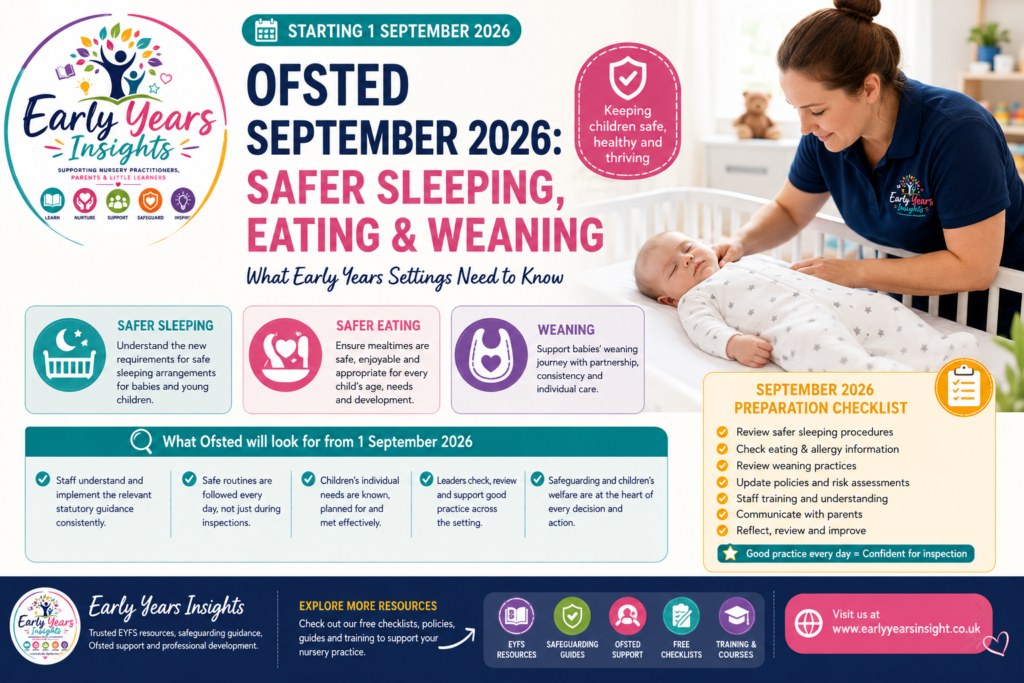
The updated Ofsted inspection guidance gives more attention to safer sleeping, weaning and safer eating. Inspectors will check that the relevant statutory guidance is understood and effectively implemented at this setting. (GOV.UK)
In this article, I will explain these changes in a simple way. I will also explain what they can look like in a real nursery, because sometimes official guidance can be more complicated to understand when you are busy working with children.
What Changes are going to happen From September 2026?
From 1 September 2026, Ofsted will use updated Early Years inspection materials as mentioned on their official page. https://www.gov.uk/government/news/inspection-materials-updated-ahead-of-september-2026
The changes include more information about practitioners’ responsibilities to protect children from harm and make them feel safe. There is also an additional focus within children’s welfare and wellbeing on safer sleeping, eating and weaning arrangements. (GOV.UK)
Ofsted says inspectors will check that settings are implementing statutory guidance for:
- babies’ safe sleeping arrangements
- weaning
- safer eating
The important word here is implementing.
Only having the policy is not enough.
All staff should understand the policy and follow it in everyday practice in the nursery.
Through my experience, this is something I have learnt from working in Early Years. A nursery can have a very good policy, but the problem is that if staff do not understand what it means when they are working with children, the policy will not be effective enough.
For example, a nursery might have a safer-sleep policy in the office.
That is good.
For example, if an inspector asks what you would do when a baby falls asleep unexpectedly and you do not know, there is a problem. The same applies to food allergies, weaning and mealtimes.
Why Are These Changes Important in the nursery?
Babies and young children depend on adults to keep them safe. They also cannot always understand risks for themselves.
A baby cannot talk to us and tell that something is wrong while they are sleeping.
A young child may not understand the danger of choking.
A child with an allergy may not understand why they have a restriction for certain food.
This is why as a practitioner, knowing the children is so important.
In my experience, practitioners work much better when they know the children in their care.
For example, you should know if a child:
- has an allergy
- has a special dietary requirement
- needs support during mealtimes
- has an individual sleep routine
- is starting to try new foods
- has a medical need
- needs additional support
As a practitioner, you do not have to remember every piece of information without checking. But what you should know where the information is and what you need to know for your role.
Safer Sleep
Safer sleep is one of the main areas practitioners need to understand.
The DfE has made the safer-sleep requirement clearer in the EYFS from September 2026. The updated guidance clearly mentions that for babies aged 12 months and under, early years providers must use a cot, carrycot, Moses basket or travel cot that meet the relevant requirements. (Help for Early Years Providers)
This is an important change for settings that care for babies.
Managers need to check their current arrangements.
Practitioners also need to understand what this means in their own room.
What does safer sleep really mean in a nursery?
Sometimes the advice can seem simple when you read it. But the hardest part is actually doing it when the room is full.
For example: imagine a baby room in the morning. One baby needs a change and another baby is playing. At the time a parent has just arrived and another baby gets tired and falls asleep.
As a practitioner, you needs to know how to deal with this situation.
They should not just make their choice because the room is busy. They need to follow the settings sleep policy and the current EYFS guidelines.
That is why staff training and communication are important.
What if a baby falls asleep unexpectedly?
Babies do not always sleep when we think they will. A baby might fall asleep while being held or an activity.
When this happens the practitioner needs to know what the settings rules say.
If you are not sure, ask.
I would rather ask a manager or a room leader than try to guess what to do.
This is also something that managers can bring up during staff meetings.
You could ask simply:
“What would you do if a baby fell asleep unexpectedly?”
Let staff explain what they would do.
If someone is not sure that gives the manager a chance to explain the way to handle it.
It is not about making the practitioner feel bad.
It is about making sure everyone knows how to keep babies safe.
Why communication is important during sleep times
Parents can give information that’s important for their child’s care.
For example, a parent might tell you that their baby’s sleep pattern has changed.
Another parent might tell you that their baby is sleeping more than usual.
The information might need to be passed on to the practitioners who care for the child.
One person knowing something is not always enough.
If another practitioner takes over later, they need to have the information they need.
Good communication can make a difference.
Safer Eating
In the nursery setting, eating is most important part of the day. Mealtimes can also be a lovely time for children. They sit together, talk, practise independence and try different foods.
But there are also risks at mealtime.
As a Practitioner you need to think about:
- allergies
- choking
- dietary requirements
- suitable foods
- children’s development
- supervision
- seating
- individual needs
- food preparation
- communication with parents
In September 2026 inspection guidance, Ofsted has specifically included safer sleeping, weaning and eating. Inspectors will check that statutory guidance is understood and effectively implemented in day-to-day routine in the nursery.
What I Have Learnt About Mealtimes
After working in Early Years, I know that mealtimes are very busy and take lot of attention.
For example: As a practitioner you may be helping one child.
Another child may want help opening their food.
Someone else may be talking.
another child may need the toilet.
There can be lots happening at the same time.
This is why practitioners need to remain aware of the children they are properly supervising.
We cannot just put food on the table and assume everything will be fine or that children will be able to do everything by themself.
It is really important before a meal; staff need to know about relevant allergies and dietary requirements about all the children who are the at the food table.
During the meal, children need appropriate supervision. If something goes wrong, as staff you need to know what to do. Most importantly do not panic. This is everyday practice, not just Ofsted preparation.
Food Allergies
Food allergies need to be taken seriously in all childcare providers.
If a child has a known allergy, the practitioners who need the information should know about it.
They should know:
- what the child is allergic to
- what food needs to be avoided
- where the information is recorded
- who needs to know
- what the setting’s procedure says
- what to do in an emergency
I would not rely on one person remembering.
If a practitioner is absent, another member of staff may need to care for the child.
The information therefore needs to be clear and available through the setting’s agreed system.
Food safety is not only the responsibility of the kitchen.
The practitioners supervising children during meals have an important role too.
Weaning
Weaning is something that settings really need to get right.
Every baby is unique. They might have their own preferences when it comes to weaning.
Parents may talk to you about weaning and tell you that their baby has started to trying new foods at home.
They might also tell you which foods their baby has already tried or if they have any worries, about weaning.
This information is really useful for the nursery to know.
For example, a parent might say:
“We have started giving our baby foods at home.”
The person looking after the baby should really listen to what the parent’s saying and do what the nursery normally does to record or share important information.
Weaning is an example of why it is so important for nurseries to work closely with parents.
Parents know their child well and weaning is a big part of that.
Working with parents who are weaning their baby is crucial
Weaning Is Not Exactly the Same for Every Baby
One thing I think people who work with children need to remember is that children grow and develop at different speeds.
We should not think that every baby will reach the milestones at the exact same time.
The way a child is growing and what they need as an individual should be taken into account.
Parents can also share details, about what is going on at home.
Those who work with children should stick to the rules of the place they are working in and the advice available instead of deciding on their own what is best.
What Will Ofsted Actually Look At?
This is probably what many people who work in the field are worried about.
“What will the inspector ask me?”
From my experience with Ofsted inspections, I would say the best thing you can do is understand your practice.
Do not try to memorise an answer.
The updated Ofsted operating guide says inspectors will focus on children’s experiences and will check that the statutory guidance for sleeping arrangements, weaning and safer eating is well understood and implemented effectively. (GOV.UK)
Inspectors may observe what happens in the room.
They may talk to practitioners.
They may talk to leaders.
They may ask about children.
They may want to understand how staff meet children’s care needs.
The updated guidance specifically says inspectors will consider each person’s knowledge of the babies and children they care for including their care needs and adherence, to the relevant statutory guidance. (GOV.UK)
So, knowing your key children is very important.
You Do Not Need to Memorise Ofsted Answers
I have been through Ofsted inspections, and one thing I would say to practitioners is:
Do not panic if an inspector asks you a question.
You do not need to sound like a textbook.
If an inspector asks:
“How do you support babies when they sleep?”
Explain what you actually do.
If they ask:
“How do you manage allergies?”
Explain your normal procedure.
If they ask:
“How do you work with parents?”
Give a real example.
An honest answer based on your everyday work is much better than trying to repeat a sentence you memorised the night before.
If you do not know something, it is better to say that you would check the procedure or speak to the appropriate person.
What Should Practitioners Do Every Day?
Know Your Children
You should know the important information about the children you care for.
For example:
- allergies
- dietary requirements
- sleep arrangements
- feeding needs
- medical information
- communication needs
- additional needs
You do not need to know everything by memory.
You should know where to find the information you need.
Follow Your Procedures
Every nursery has procedures.
These may include:
- safeguarding
- safer sleep
- food safety
- allergies
- risk assessment
- emergency procedures
- recording and reporting
Make sure you know where to find them.
If you are unsure, ask.
Do not guess.
Communicate With Your Team
This is something I believe is very important in Early Years.
Imagine that a parent gives important information to one practitioner at drop-off.
That practitioner might finish their shift later.
Another practitioner may then take over.
If the information is not passed on properly, there is a risk that the second practitioner will not know what they need to know.
This is why good handovers and communication matter.
Important information about sleep, food, allergies, medical needs or safeguarding should be dealt with through your setting’s agreed procedures.
Working With Parents
Parents are part of the child’s care.
They know things about their child that we may not know.
They might tell you:
“My child has not been eating much this week.”
Or:
“My baby has started trying new foods.”
Or:
“My child has been sleeping differently.”
We should listen to this information.
Good partnership does not mean agreeing with everything a parent says or telling them what to do.
It means listening, sharing information appropriately and working together to support the child.
Children With Additional Needs
Every child is different.
Some children may need more support with eating, sleeping or changes to their routine.
For example, a child may:
- need extra time during meals
- need additional adult support
- have a dietary requirement
- communicate differently
- become anxious when routines change
- need an adjustment to the environment
Practitioners need to think about the child’s individual needs.
If you are concerned about a child’s development or additional needs, speak with your SENCO or another appropriate person in your setting.
Ofsted’s updated guidance also places attention on key persons’ knowledge of individual children and how their needs are being met. (GOV.UK)
What Should Managers Do Before September?
Managers should not simply send staff a new policy and ask everyone to sign it.
I think discussion is much more useful.
At a staff meeting, choose some situations that could actually happen in your nursery.
For example:
A baby falls asleep unexpectedly. What would you do?
A child with an allergy is sitting down for lunch. What would you check?
A parent tells you their baby has started trying new foods. What information should be shared?
Ask staff to explain their answers.
This can help managers see whether staff understand the procedures.
If someone is unsure, use it as a learning opportunity.
A Simple Staff Activity
You could use the following during your next staff meeting.
Situation 1: Sleep
A baby becomes very tired and falls asleep.
Ask:
What would you do?
What does your nursery procedure say?
Who would need to know?
Situation 2: Food allergy
A child with an allergy is having lunch.
Ask:
What would you check before giving the child their food?
Who needs to know?
Situation 3: Weaning
A parent tells you that their baby has started trying new foods.
Ask:
What information might be important?
How would you communicate it?
This is a simple activity, but it can tell you a lot about staff understanding.
Do You Need to Create Lots of New Paperwork?
This is one question I know many practitioners and managers will ask.
No, not just for Ofsted.
Ofsted says inspectors use first-hand evidence and focus on children’s experiences and the effectiveness of leaders’ actions. (GOV.UK)
So I would not create lots of forms just because you are worried about the inspection.
Instead, look at your actual practice.
Ask:
Are staff following the procedure?
Do staff understand it?
Are children safe?
Do staff know the individual children?
Is important information being shared?
If something is not working, fix the problem.
More paperwork will not automatically make the practice safer.
Safeguarding and the September 2026 Changes
Safer sleep, weaning and eating are also connected to safeguarding.
Ofsted explains that safeguarding and children’s welfare and wellbeing are at the heart of how care practices are considered during inspection. (Early Years Blog)
This is important because sometimes people think of safeguarding as only reporting abuse or neglect.
Safeguarding is much wider than that.
Keeping children safe during everyday care is also important.
If a setting has a policy but staff are not following it, managers need to understand why.
Maybe staff need more training.
Maybe the procedure is not clear.
Maybe new staff have not received enough induction.
Maybe communication needs improving.
The important thing is to identify the problem and take action.
Common Mistakes I Would Avoid
1. Only updating the policy
Updating the policy is useful, but staff also need to understand it.
2. Trying to memorise Ofsted answers
You do not need a perfect answer.
Know your practice and explain it naturally.
3. Assuming another practitioner knows
If information is important, make sure it is shared properly.
4. Thinking food safety is only the kitchen’s job
Practitioners supervising children during meals also have responsibilities.
5. Forgetting parents
Parents can give us important information about their child’s routine and needs.
6. Creating paperwork instead of improving practice
A large folder does not automatically mean good practice.
7. Being afraid to ask
If you are unsure, ask your manager or the appropriate person.
It is better to ask than guess.
My Advice After Going Through Ofsted Inspections
Having worked in Early Years for four years and experienced Ofsted inspections, my biggest advice is:
Know what you are doing and know why you are doing it.
You do not need to know every sentence in every policy.
But if you are working in a baby room, you should understand the important procedures for the babies you care for.
If you are supervising lunch, you should understand the children’s food and allergy needs.
If you are a key person, you should know your children well.
If you have a concern, you should know who to speak to.
And if an inspector asks you a question, try not to panic.
Think about what you normally do.
Then explain it honestly.
My Simple Ofsted Preparation Checklist
Safer Sleep
☐ Do I understand the current safer-sleep requirements?
☐ Do I know the sleep arrangements for the babies I care for?
☐ Do I know what to do if a baby falls asleep unexpectedly?
☐ Do I know where to find the correct information?
Eating
☐ Do I know which children have allergies?
☐ Do I know about dietary requirements?
☐ Do I understand my role during mealtimes?
☐ Do I know what to do if there is a problem?
Weaning
☐ Do I understand how our setting supports babies who are being weaned?
☐ Do I know how information from parents is shared?
☐ Do I know who I should speak to if I am unsure?
Safeguarding
☐ Do I know who the DSL is?
☐ Do I know how to report a concern?
☐ Do I understand my responsibility to keep children safe?
Teamwork
☐ Do I communicate important information with colleagues?
☐ Do I listen to parents?
☐ Do I ask when I am unsure?
☐ Can I explain my practice in my own words?
Frequently Asked Questions
When do the new Ofsted changes start?
The updated Early Years inspection materials will be used from 1 September 2026. (GOV.UK)
Will Ofsted check safer sleep?
Yes. Inspectors will check that statutory guidance for babies’ safe sleeping arrangements is understood and effectively implemented. (GOV.UK)
Will Ofsted check weaning?
Yes. Weaning is included in the updated inspection guidance. (GOV.UK)
Will Ofsted check safer eating?
Yes. Inspectors will check that the statutory guidance for safer eating is understood and implemented effectively.
Do practitioners need to memorise the new requirements?
No.
You need to understand the requirements that apply to your role and be able to explain what you actually do.
Do we need lots of new paperwork?
Not simply because of Ofsted.
The focus is on children’s experiences and what happens in practice. (GOV.UK)
What should managers do first?
Read the updated guidance, review current practice and talk to staff.
What should I do if I am unsure?
Do not guess.
Check your setting’s procedure and speak to your manager, DSL, SENCO or another appropriate person.
Final Thoughts
After having four years’ experience of working in Early Years and going through Ofsted inspections, I have learnt that preparing for Ofsted is not about making everything look perfect and memorized the answers for some questions for one day.
It’s all about what we do every day in the nursery.
- A baby needs to be cared for safely when sleeping.
- Children need to be supervised properly when eating.
- Staff need to understand allergies and dietary requirements.
- Babies need appropriate support when they are being weaned.
- Parents need to be listened to.
- Practitioners need to communicate with each other.
- And children need adults who know them well.
The September 2026 changes may seem like another thing for Early Years settings to prepare for, and looks like hard to manage, but I think they are also a good opportunity to stop and look at our everyday practice.
Ask yourself:
Are we doing things safely?
Do our staff understand why we do them?
Are our procedures actually being followed?
Do we know the children well?
Are we working properly with parents?
Do staff feel confident enough to ask questions?
These questions are more useful than simply asking:
“What will Ofsted want to see?”
Ofsted’s updated approach continues to focus on children’s experiences and on whether leaders’ actions support children to achieve, belong and thrive. (GOV.UK)
So, rather than trying to prepare a perfect answer, prepare your everyday practice.
Read the current guidance.
Talk to your team.
Check your procedures.
Listen to parents.
Look at what is happening in your rooms.
If something needs improving, improve it.
That is the best way I know to prepare for Ofsted.
And most importantly, it is the best way to keep the children in our care safe.
Official guidance
For the latest information, always check the official sources: