
Table of Contents
Introduction
Every child who comes into a nursery is really different. They are coming from different families, cultures, tradition and backgrounds. Some children speak English well before starting nursery, while others may not speak English because they use their mother’s or father’s language at home. These children are just beginning to learn English.
As Early Years practitioners, who don’t make children to forget their home language. Our responsibility is to help them feel safe, welcome and confident while giving them opportunities to develop their English naturally.
I have worked in Early Years for four years, and one thing I have learnt is that children learn much better when they feel comfortable with the adults around them. This is especially important for children who are learning English as an additional language.
Sometimes a child may understand what we are saying but may not feel confident enough to answer in English. This does not always mean that the child has a speech or language delay.
Every child has their own way of learning.
In my experience, giving children time, using simple language, showing them what we mean and joining them in their play can make a big difference.
At Early Years Insight, I believe that speaking more than one language is something to celebrate, A child’s home language is an important part of who they are. Practitioners can build on this strength while helping children develop their English.
This guide explains what EAL means and shares practical ideas that Early Years practitioners can use in everyday nursery practice.
What Does English as an Additional Language Mean?
English as an Additional Language, often called EAL, describes children who are learning English when they already speak or hear another language.
For example, a child may speak Tamil, Polish, Arabic, Urdu, Romanian or another language with their family and use Englisg at nursery.
Being an EAL child does not automatically mean that the child has a speech or language delay.
Some children may understand a lot of English but speak very little at first. Other may watch and listen for some time before they start using English themselves.
Every child is different.
Some children start using English quickly. Others need much more time.
There can also be a period when a child listens carefully but does not speak much English. This is sometimes called the silent period. Practitioners should not automatically assume that a quiet EAL child has a developmental problem.
The EYFS Statutory Framework expects practitioners to recognise children’s individual needs and provide opportunities for communication and language development.
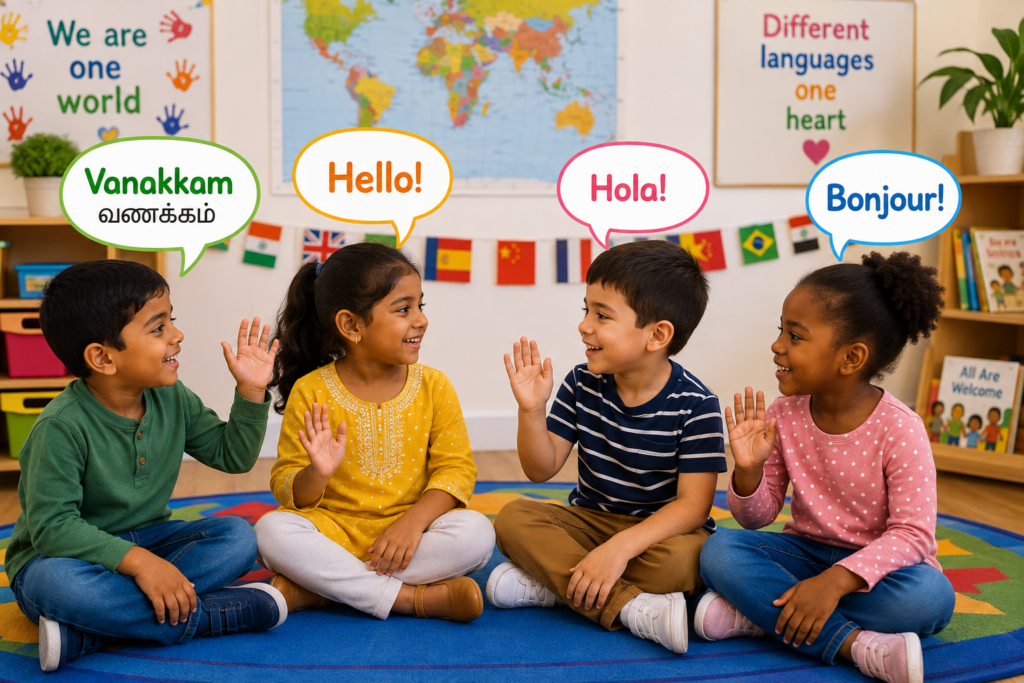
Understanding Bilingualism
A bilingual child is able to understand, speak or use two or more languages. Some children hear two languages from birth, while others begin learning English after joining nursery.
Research has consistently shown that bilingualism offers many long-term advantages. Learning more than one language does not confuse children. Instead, it strengthens their ability to communicate, solve problems and understand different cultures.
Every language a child speaks forms part of their identity. Practitioners should never discourage families from using their home language. Instead, both languages should be valued and celebrated.
The Development Matters guidance encourages practitioners to build on children’s interests, experiences and existing knowledge when planning learning opportunities.
Why Supporting Bilingual Children Matters
Imagine arriving in a new country where nobody speaks your language. Everyday tasks such as asking for a drink, finding the toilet or joining a conversation could feel overwhelming.
This is how many EAL children feel during their first few weeks in nursery.
By creating a welcoming environment, practitioners help children feel emotionally secure. Children who feel safe are more likely to:
- Explore new activities.
- Build friendships.
- Join conversations.
- Develop confidence.
- Enjoy learning.
- Communicate their needs.
Supporting bilingual children benefits everyone in the setting. English-speaking children also learn to appreciate different cultures, languages and ways of communicating.
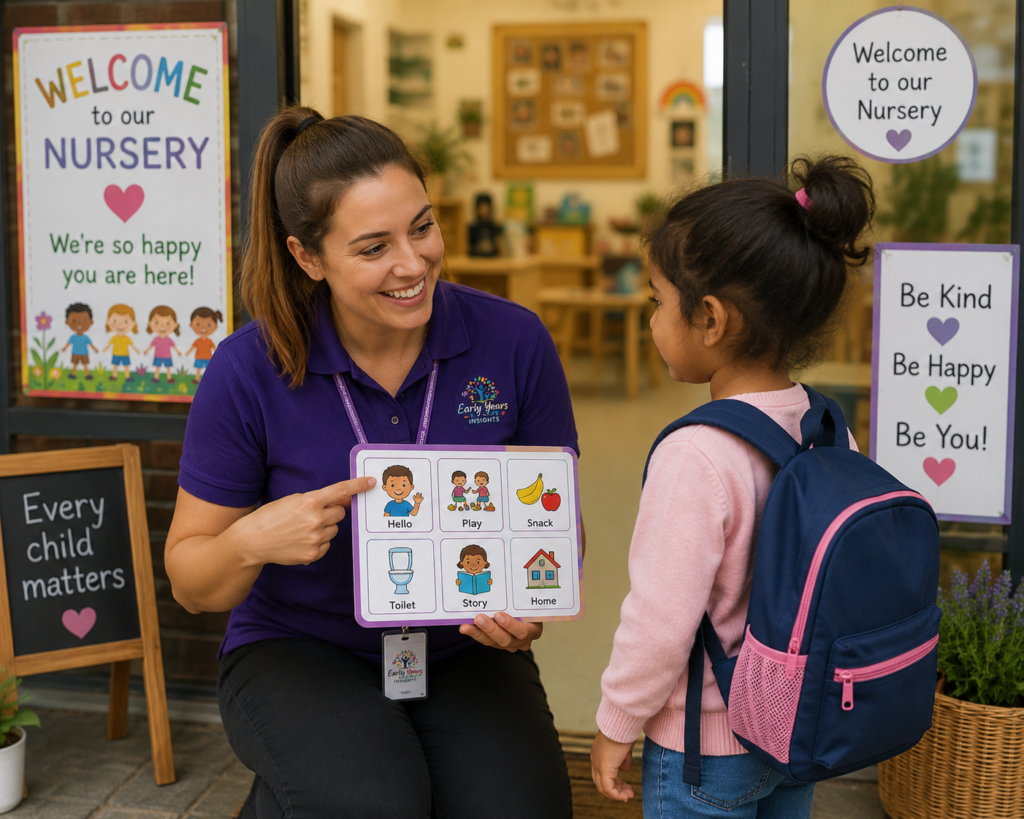
Benefits of Being Bilingual
Many families worry that learning two languages might delay speech or make children confused. In reality, bilingualism offers many lifelong benefits.
Stronger Communication Skills
Children who hear more than one language often develop excellent listening skills because they learn to recognise different sounds, words and expressions.
Better Problem-Solving Skills
Moving between languages encourages flexible thinking. Children learn to adapt their communication depending on who they are speaking with.
Greater Cultural Awareness
Speaking more than one language helps children understand different traditions, celebrations and family experiences. It encourages respect, empathy and inclusion from an early age.
Improved Confidence
When practitioners celebrate children’s home languages, children feel proud of who they are. Confidence grows when children see their language represented in books, displays and conversations.
Common Myths and Facts About EAL Children
Misunderstandings about bilingualism still exist. Understanding the facts helps practitioners provide better support.
| Myth | Fact |
|---|---|
| Children should stop speaking their home language. | Children benefit from continuing to develop both their home language and English. |
| Speaking two languages causes confusion. | Children naturally learn to separate languages over time. |
| Quiet children always have language difficulties. | Many EAL children experience a silent period while learning English. |
| Parents should only speak English at home. | Families should continue using the language they speak most confidently. Rich conversations in any language support learning. |
| EAL children cannot achieve as well as English-speaking children. | With high-quality support, EAL children can make excellent progress across all areas of learning. |
Real Nursery Experience
One child joined our nursery speaking mainly Tamil. During the first few days, he watched other children carefully but rarely joined conversations.
Rather than expecting him to speak English immediately, practitioners focused on building trust. We used visual timetables, simple gestures, picture cards and consistent daily routines. Parents shared favourite songs from home, which we included during circle time.
Within a few weeks, the child began joining group activities. He smiled more often, interacted with friends and gradually started using simple English words while continuing to communicate confidently in Tamil with his family.
This experience reminded us that language develops naturally when children feel secure, valued and included.
Professional Tip from Early Years Insight
Children often understand much more English than they are able to speak. Avoid measuring progress only by spoken language. Observe children’s understanding, confidence, relationships and participation during everyday play.
Practical Strategies to Support Bilingual and EAL Children in Early Years
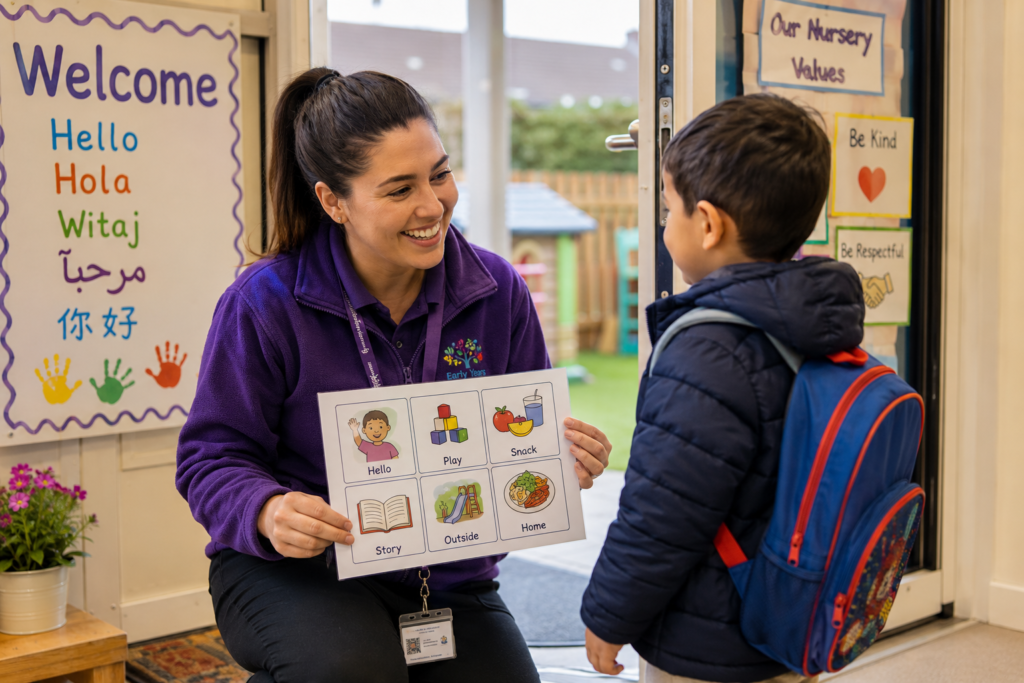
Now that we understand what bilingualism is and why it should be celebrated, the next step is to explore how practitioners can support bilingual and EAL children every day. High-quality practice is not about expecting children to learn English quickly. It is about creating an environment where they feel safe, confident and included.
Every child learns differently. Some children begin speaking English within a few weeks, while others may spend several months listening before using new words. Both approaches are completely normal. Our role is to provide rich language experiences through play, positive relationships and meaningful interactions.
Creating an Inclusive Learning Environment
An inclusive learning environment allows every child to feel respected, valued and represented. Children are more likely to communicate when they feel emotionally secure and know that their culture and language are welcomed.
Simple ways to create an inclusive nursery include:
- Display welcome signs in the languages spoken by your families.
- Label key areas with both pictures and words.
- Include books featuring diverse families and cultures.
- Provide multicultural dolls, puzzles and role-play resources.
- Celebrate festivals represented within your setting.
- Display family photographs where children can easily see them.
These small changes send a powerful message that every child belongs.
Professional Tip
An inclusive environment benefits all children, not only EAL learners. It encourages respect, curiosity and understanding of different cultures from an early age.
Helping Children Settle into Nursery
The first few weeks are extremely important. Children who are learning English may feel anxious because everything around them is unfamiliar.
Practitioners can support children by:
- Greeting them warmly every morning.
- Using simple language supported by gestures.
- Keeping routines consistent.
- Allowing children time to observe before expecting participation.
- Pairing them with a friendly buddy during activities.
- Providing comfort objects where appropriate.
Avoid putting pressure on children to speak English immediately. Building trust should always come first.
Real Nursery Example
A little girl joined our nursery from Poland. During her first week she preferred to watch other children rather than join in. Instead of encouraging her to answer lots of questions, her key person sat beside her during play, smiled, commented on what she was doing and used picture cards to explain routines.
After two weeks she began pointing to resources and smiling at her friends. By the end of the term she was joining role-play activities, singing familiar nursery rhymes and using short English sentences while continuing to speak Polish confidently at home.
Her progress came from feeling safe, not from being rushed.
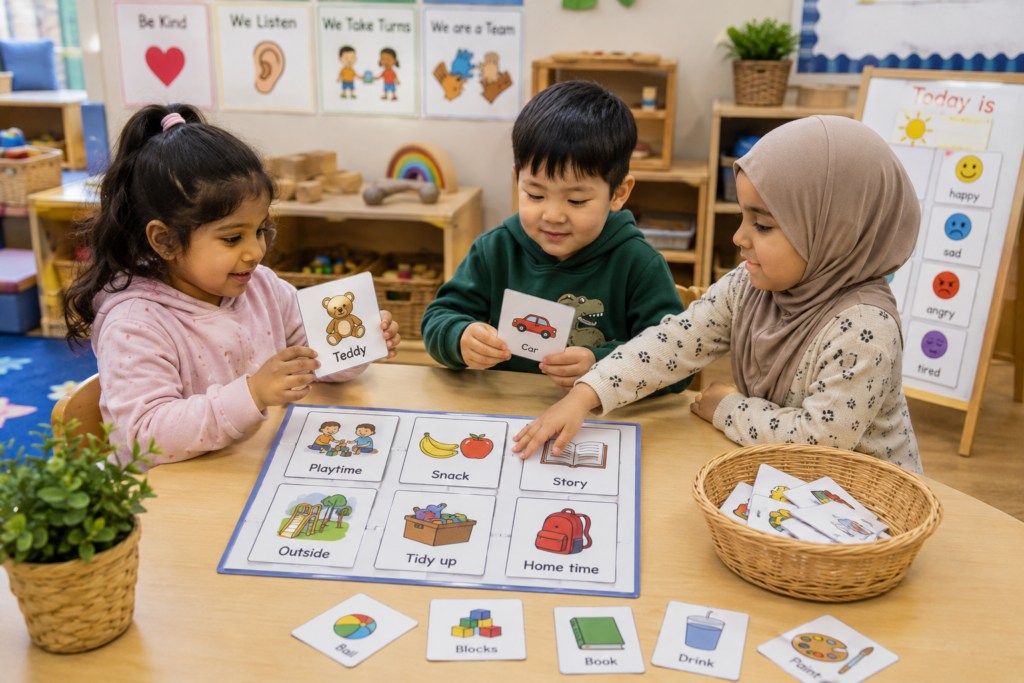
Using Visual Supports
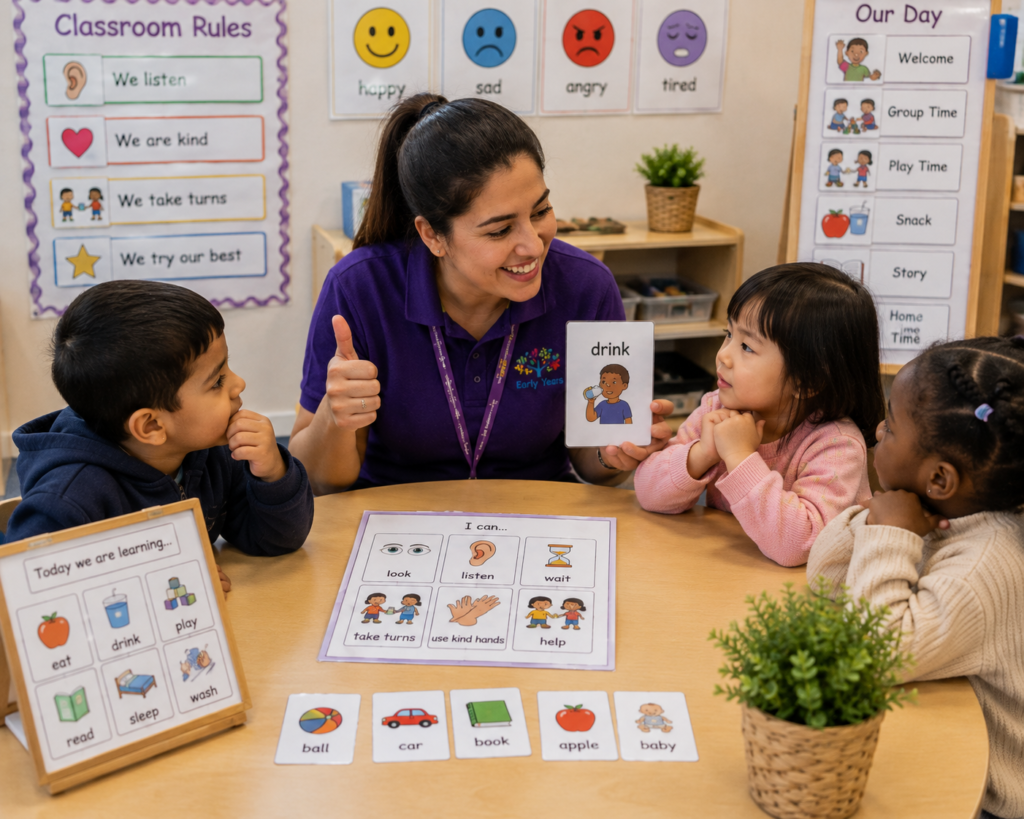
Visual communication is one of the most effective strategies for supporting bilingual children.
Pictures often communicate more clearly than spoken instructions.
Useful visual resources include:
- Visual timetables
- Toilet signs
- Snack choices
- Emotion cards
- Handwashing posters
- Story time symbols
- Tidy-up cards
- Outdoor play symbols
Children quickly learn routines because they can see what is expected.
Visual supports also encourage independence and reduce frustration.
Modelling Language Naturally
Children learn language through everyday conversations rather than formal lessons.
Instead of asking children to repeat words, model rich language naturally.
For example:
Child: “Car.”
Practitioner: “Yes, that’s a big red car. It’s driving very fast.”
Another example:
Child: “Water.”
Practitioner: “You would like some more water. Let’s pour the water into your cup.”
These conversations introduce new vocabulary without making children feel pressured.
Supporting the Silent Period
Many EAL children experience what practitioners describe as the silent period. During this stage children may:
- Listen carefully.
- Watch other children.
- Use gestures instead of words.
- Smile or nod rather than speak.
This is a normal part of learning another language.
Practitioners should continue talking naturally, modelling language and encouraging participation without forcing children to speak before they are ready.
If you have concerns about a child’s overall communication or development, discuss your observations with parents and follow your setting’s SEND procedures where appropriate.
Language Development Through Play
Children learn best through play.
Every area of continuous provision offers opportunities for communication.
Role Play
Role-play areas introduce everyday vocabulary such as:
- Family
- Cooking
- Shopping
- Doctor
- Baby
- Home
Ask open-ended questions such as:
“What are you cooking today?”
“Who is coming to dinner?”
“How can we help the baby?”
Internal Link:
Read our guide to Continuous Provision in Early Years for more ideas about creating language-rich learning environments.
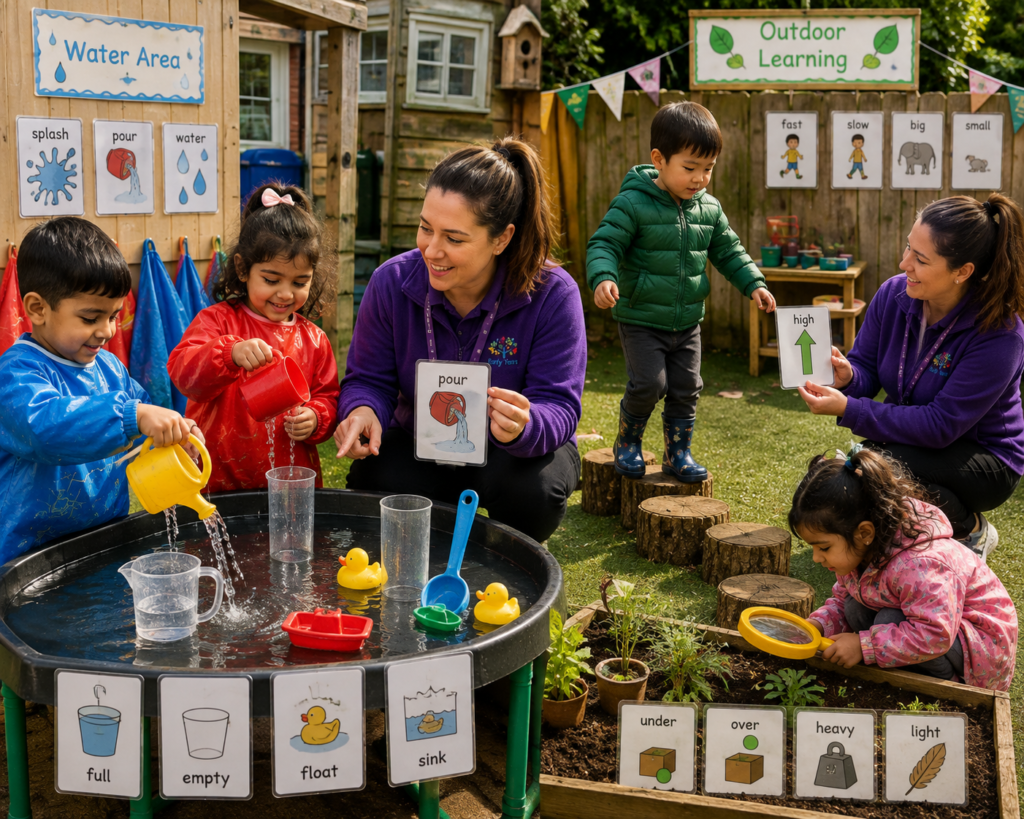
Water Play
Introduce vocabulary naturally:
- Full
- Empty
- Float
- Sink
- Splash
- Pour
Children remember words more easily when they are linked to meaningful experiences.
Outdoor Learning
Outdoor environments provide endless opportunities for communication.
Model words such as:
- Fast
- Slow
- High
- Low
- Under
- Over
- Heavy
- Light
Encourage children to describe what they can see, hear and feel.
Supporting Home Language
Some families worry that they should only speak English at home.
In fact, maintaining a child’s home language helps them develop stronger communication skills overall.
Encourage parents to:
- Read stories in their home language.
- Sing songs together.
- Share family traditions.
- Talk about everyday activities.
- Visit the local library for bilingual books if available.
When children have a strong foundation in their first language, they often find it easier to develop English as well.
The National Literacy Trust highlights the importance of talking, reading and sharing stories with children every day. You can also explore free family resources from BBC Tiny Happy People.
Building Positive Partnerships with Parents
Parents know their child best.
Working together helps practitioners understand:
- Favourite activities
- Comfort items
- Family traditions
- Home language
- Interests
- Daily routines
Simple ways to strengthen partnerships include:
- Daily conversations.
- Stay-and-play sessions.
- Family workshops.
- Home learning ideas.
- Sharing observations regularly.
Strong partnerships create consistency between home and nursery.
Supporting Language Through Stories
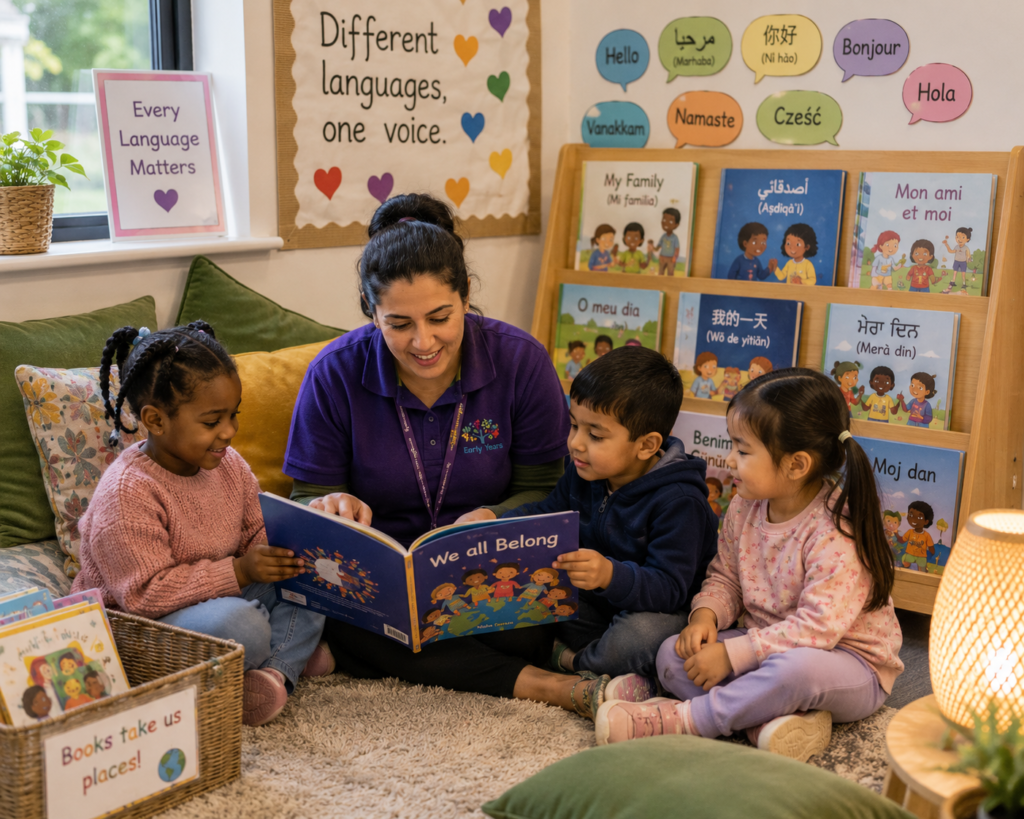
Story time is one of the most effective ways to develop communication and language.
Choose books with:
- Bright illustrations.
- Repeated phrases.
- Diverse characters.
- Predictable storylines.
Encourage children to:
- Point to pictures.
- Predict what happens next.
- Retell familiar stories.
- Act out characters.
Reading together also supports listening, attention and early literacy.
Linking Practice to the EYFS
Supporting bilingual and EAL children contributes to several areas of learning within the Early Years Foundation Stage.
- Communication and Language
- Personal, Social and Emotional Development
- Literacy
- Understanding the World
The EYFS Statutory Framework explains that practitioners should provide opportunities that build on children’s individual strengths and starting points.
The Development Matters guidance also encourages practitioners to create language-rich environments where children learn through play, exploration and positive relationships.
Key Reflection Questions
Before moving on, ask yourself:
- Does every child feel represented in my classroom?
- Do I celebrate home languages?
- Are my resources culturally inclusive?
- Do I give children enough time to communicate?
- How do I know my strategies are making a difference?
Reflective practice helps practitioners improve outcomes for every child.
Ofsted Expectations, Continuous Provision and Assessing Progress for Bilingual & EAL Children
One of the questions practitioners often ask is, “What does Ofsted expect to see when supporting bilingual and EAL children?”
The good news is that Ofsted does not expect children learning English as an additional language to speak fluent English quickly. Instead, inspectors focus on the quality of teaching, relationships, inclusion, and how practitioners help every child make progress from their individual starting points.
Outstanding practice is about understanding children’s needs, creating a language-rich environment and working closely with families to support learning both at nursery and at home.
What Ofsted Looks for When Supporting EAL Children
During an inspection, Ofsted may observe how practitioners communicate with children, organise the learning environment and adapt activities to meet individual needs.
Inspectors are interested in whether practitioners:
- Build warm and trusting relationships.
- Value children’s home languages and cultures.
- Encourage communication through play.
- Provide a language-rich environment.
- Use visual supports effectively.
- Work in partnership with parents.
- Understand each child’s starting point.
- Plan learning based on observations.
- Promote confidence and independence.
Rather than expecting children to speak English immediately, inspectors want to see practitioners helping children feel safe, included and motivated to communicate.
Outstanding Practice in Everyday Nursery Life
Outstanding practice is often found in simple everyday interactions.
For example, instead of asking a new EAL child lots of questions, an experienced practitioner might sit alongside the child during block play and comment naturally:
“You’re building a tall tower.”
“Look, the blue block goes on top.”
“Wow, it’s getting even bigger!”
This approach models vocabulary without placing pressure on the child to respond. It creates meaningful opportunities for language development while respecting the child’s confidence and stage of learning.
Continuous Provision Ideas for Supporting EAL Children
Children develop language best through purposeful play. Every area of continuous provision provides valuable opportunities to introduce new vocabulary.
Home Corner
The home corner is one of the richest language environments in the nursery.
Provide:
- Multicultural food packaging.
- Dolls representing different ethnicities.
- Dressing-up clothes from different cultures.
- Telephones.
- Shopping lists.
- Recipe books.
- Family photographs.
Model words such as:
- Cook
- Plate
- Spoon
- Wash
- Baby
- Family
- Hungry
- Full
Encourage children to role-play everyday experiences that are familiar to them.
Construction Area
Construction encourages mathematical language and problem-solving.
Introduce vocabulary such as:
- Build
- Tall
- Short
- Heavy
- Balance
- Strong
- Bridge
- Tower
Ask open-ended questions like:
“What could make your tower stronger?”
“How can we make it taller?”
Water Play
Water play introduces scientific vocabulary naturally.
Use words including:
- Pour
- Empty
- Full
- Float
- Sink
- Splash
- Wet
- Deep
- Shallow
Allow children to experiment while modelling language throughout their play.
Small World Play
Small world resources encourage storytelling and imagination.
Use:
- Farm animals.
- Dinosaurs.
- Transport.
- Families.
- Community helpers.
Encourage children to describe what is happening rather than asking questions that require one-word answers.
Creative Area
Art activities create excellent opportunities for conversation.
Introduce vocabulary such as:
- Mix
- Paint
- Brush
- Colour
- Pattern
- Soft
- Smooth
- Sticky
Celebrate children’s creativity without focusing on producing identical outcomes.
Outdoor Learning
Outdoor environments naturally encourage communication.
Introduce language connected with:
- Nature.
- Movement.
- Position.
- Weather.
- Sizes.
- Textures.
Outdoor learning allows children to experience language using all their senses.
Real Nursery Experience
One morning our preschool children explored the outdoor mud kitchen. A child who had recently joined from Sri Lanka was initially reluctant to speak English.
Rather than asking direct questions, the practitioner joined the play and described what was happening.
“You’re mixing the mud.”
“The water is making it wet.”
“You’re making soup.”
Soon other children copied the language. The child began repeating individual words before confidently joining conversations a few weeks later.
This demonstrated how meaningful play encourages communication more effectively than formal teaching.
Assessing Progress in EAL Children
Assessment should focus on the child’s overall communication, not simply the number of English words they can say.
Observe:
- Eye contact.
- Understanding of routines.
- Use of gestures.
- Confidence during play.
- Friendships.
- Listening skills.
- Non-verbal communication.
- Engagement during group activities.
- Responses to stories and songs.
Many children understand much more English than they are able to speak.
Avoid making assumptions based solely on spoken language.
Recording Effective Observations
High-quality observations should describe what the child can do, rather than focusing only on what they cannot yet do.
Example Observation
Observation
During water play, Ahmed watched another child pouring water between containers. He smiled, copied the action and said “more water” while pointing towards the jug. He maintained attention throughout the activity and shared resources appropriately with his peers.
Assessment
Ahmed is becoming increasingly confident using English during familiar activities. He demonstrates good understanding of simple instructions and communicates successfully using gestures alongside emerging spoken language.
Next Steps
- Continue modelling descriptive vocabulary during water play.
- Encourage small-group storytelling.
- Introduce picture sequencing activities.
- Continue working with parents to support both English and home language development.
When Should Practitioners Be Concerned?
Learning English takes time.
However, practitioners should seek additional support if concerns exist across all languages, rather than only in English.
Possible indicators include:
- Limited understanding in both languages.
- Very little communication through speech or gestures.
- Difficulty interacting with familiar adults.
- Delayed development across several areas of learning.
- Concerns shared by parents.
Where concerns remain, follow your setting’s SEND procedures and work with parents and relevant professionals.
Common Mistakes to Avoid
Even experienced practitioners can make mistakes when supporting EAL children.
Avoid:
- Expecting children to speak English immediately.
- Asking too many closed questions.
- Discouraging the use of home languages.
- Assuming quiet children have speech delays.
- Correcting every pronunciation mistake.
- Comparing children with fluent English speakers.
- Translating every conversation instead of modelling natural English.
Children make the best progress when practitioners provide rich language experiences without pressure.
Professional Reflection
Consider your own practice.
Ask yourself:
- Does my environment reflect the cultures of the children attending my setting?
- Do I celebrate children’s home languages every day?
- Am I giving children enough thinking and response time?
- How effectively do I use visual supports?
- How do I involve parents in language development?
- What could I improve tomorrow?
Reflective practice is one of the strongest indicators of high-quality early years provision.
Useful Resources
Internal Resources (EarlyYearsInsight)
Essential Ofsted Changes 2026: A Complete Guide for Early Years Practitioners
https://earlyyearsinsight.co.uk/ofsted-changes-2026-early-years/
External Resources
Use these official links in your article:
- EYFS Statutory Framework
https://www.gov.uk/government/publications/early-years-foundation-stage-framework–2 - Development Matters
https://www.gov.uk/government/publications/development-matters - Ofsted Early Years
https://www.gov.uk/government/organisations/ofsted - National Literacy Trust (Supporting EAL)
https://literacytrust.org.uk/ - The Bell Foundation (EAL Guidance)
https://www.bell-foundation.org.uk/
Working in Partnership with Parents and Families to Support Bilingual and EAL Children
Parents are a child’s first and most important teachers. Before children start nursery, they have already learned thousands of words, family routines, songs, traditions and ways of communicating from home. For bilingual and EAL children, this foundation is even more valuable because it gives them confidence, identity and a secure sense of belonging.
One of the biggest mistakes practitioners can make is believing that parents should stop speaking their home language. Research and current EYFS guidance continue to encourage families to maintain and celebrate their first language while children develop English naturally through meaningful experiences. A strong first language supports cognitive development, communication skills and future learning.
Why Partnership with Parents Matters
Children make the greatest progress when practitioners and families work together with shared goals.
Everyday conversations with parents help practitioners understand:
- The child’s interests
- Favourite books and songs
- Home language spoken
- Cultural celebrations
- Family routines
- Health or developmental needs
- New vocabulary children use at home
- Children’s confidence outside nursery
These discussions create a complete picture of the child instead of relying only on observations made within the nursery environment.
Development Matters explains that strong partnerships with parents help children thrive and that the learning children experience at home has a significant impact on their development.
Respecting Home Languages
One question I have heard many times in practice is:
“Should parents only speak English at home?”
The answer is No.
Families should be encouraged to continue speaking the language they feel most confident using.
When parents communicate naturally in their first language they provide:
- richer conversations
- stronger emotional connections
- better storytelling
- wider vocabulary
- cultural identity
- family relationships
Children can successfully develop English in nursery while maintaining their home language.
In our nursery, we always reassure parents that using Tamil, Sinhala, Urdu, Polish, Arabic, Romanian or any other language at home is something to celebrate—not something to replace.
Building Trust with Families
Trust develops over time through small daily interactions.
Simple examples include:
- Greeting families warmly every morning.
- Learning how to pronounce children’s names correctly.
- Asking parents about weekends and family events.
- Sharing positive moments—not only concerns.
- Showing photographs of children’s achievements.
- Celebrating cultural festivals together.
- Listening carefully to parents’ opinions.
Families who feel welcomed are much more likely to share important information about their child.
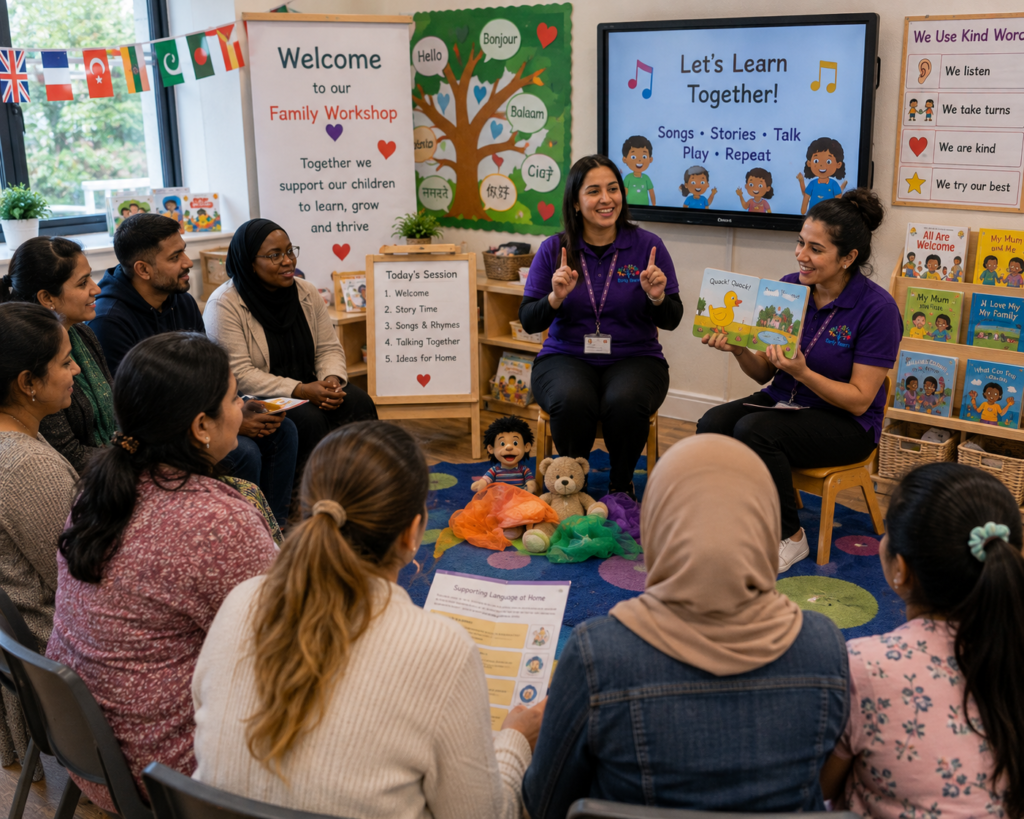
Communicating with Families Who Speak Little English
Many parents feel nervous when communicating in English.
Practitioners should never assume that families understand everything being said.
Helpful strategies include:
- Using photographs.
- Picture cards.
- Visual timetables.
- Translation apps when appropriate.
- Simple English.
- Short sentences.
- Gestures and facial expressions.
- Interpreters when required.
- Written translations for important documents.
Small changes make communication much more accessible.
Sharing Learning at Home
Learning does not stop when children leave nursery.
Families can support language development through simple everyday experiences such as:
- Reading books together.
- Singing nursery rhymes.
- Talking during shopping trips.
- Naming objects around the home.
- Cooking together.
- Looking at family photographs.
- Playing board games.
- Visiting the local library.
- Talking during walks.
These everyday experiences develop vocabulary far more naturally than formal lessons.
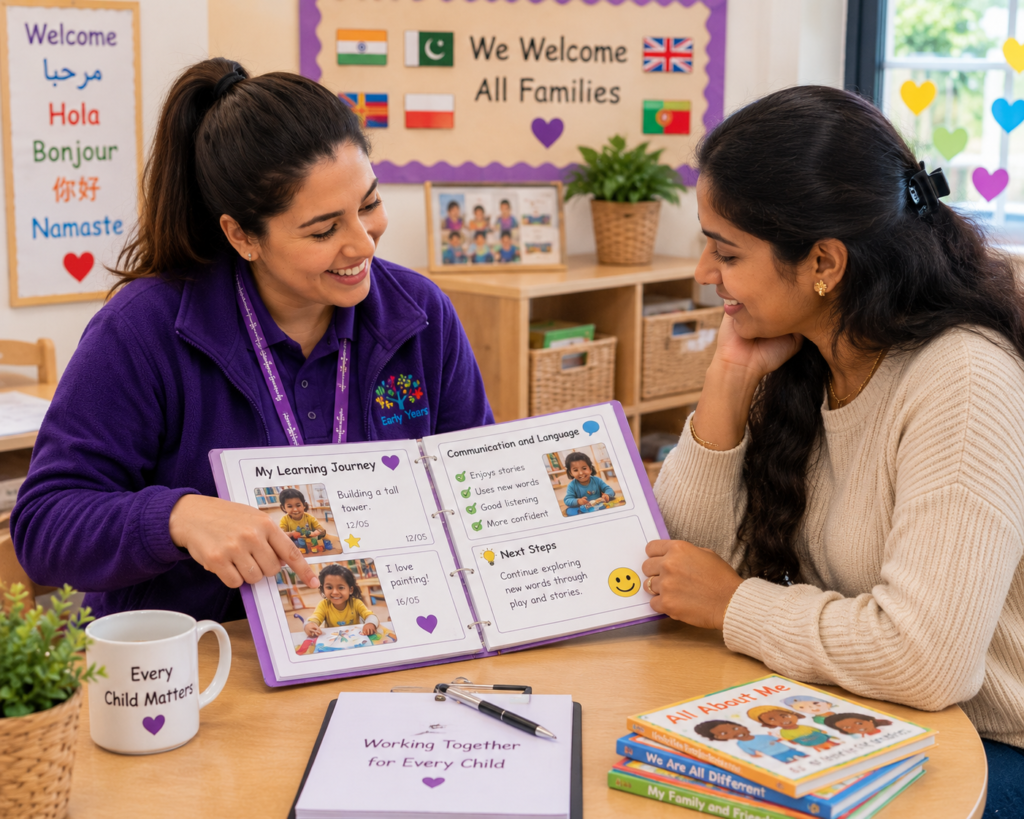
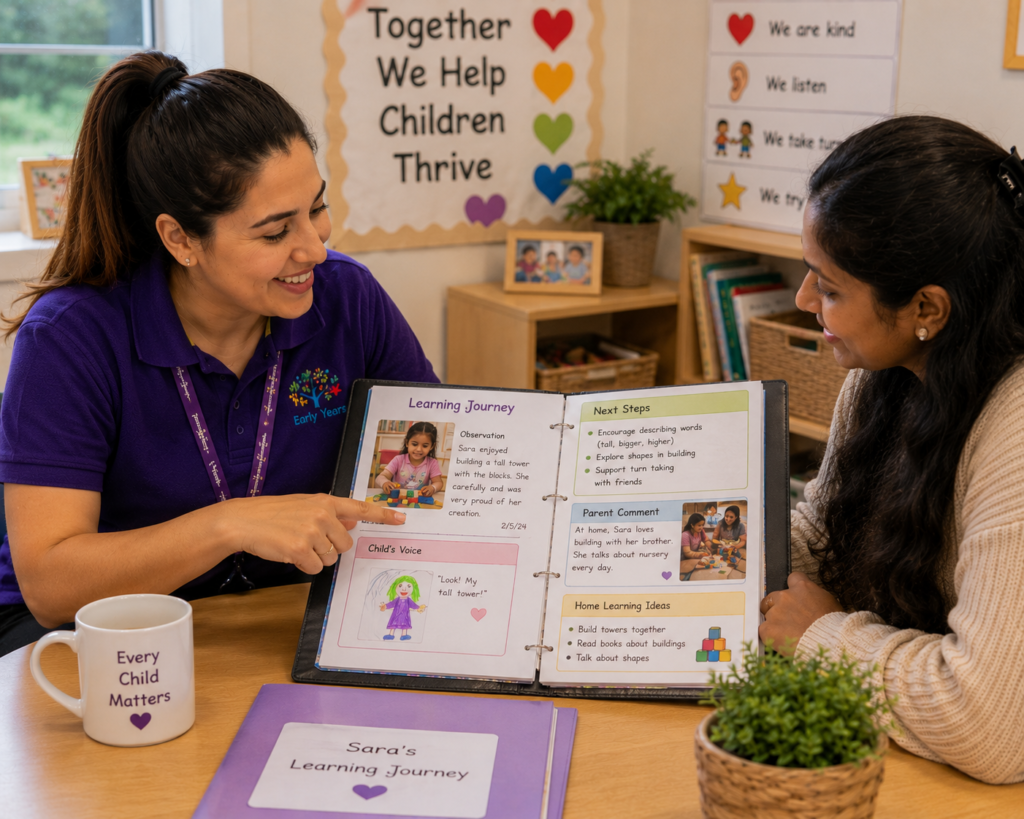
Using Learning Journals Effectively
Learning Journals are not just collections of photographs.
They should tell the story of a child’s learning journey.
Good Learning Journals include:
- observations
- children’s voice
- parent comments
- photographs
- next steps
- home learning ideas
- achievements from home
- practitioner reflections
Parents often notice achievements that practitioners do not see in nursery.
Equally, practitioners observe learning behaviours that families may not witness at home.
Combining both creates a fuller understanding of the child’s development.
Celebrating Cultural Diversity
Children feel proud when they see their own culture reflected within the nursery.
Ideas include:
- multilingual welcome signs
- dual-language books
- cultural celebration days
- family photographs
- traditional music
- world maps
- multicultural role-play resources
- cooking activities
- parents visiting to share stories
Representation helps children develop confidence, belonging and respect for others.
What Ofsted May Ask (2026)
Under the renewed inspection approach, inspectors continue to explore how settings build meaningful partnerships with families and use that information to support children’s learning and wellbeing.
Question 1
How do you involve parents in children’s learning?
Example Answer
Parents contribute observations through Learning Journals, home learning activities and regular discussions. We value their knowledge of their child and use this information when planning next steps.
Question 2
How do you support families who speak little English?
Example Answer
We use visual communication, translated information where appropriate, simple language, photographs and interpreters when needed. We encourage parents to continue using their home language while children develop English naturally.
Question 3
Why is maintaining the home language important?
Example Answer
A strong first language supports communication, emotional security, identity and later learning. Children do not need to stop using their home language to become confident English speakers.
Question 4
How do you know parents are involved?
Example Answer
Parents regularly contribute observations, attend meetings, join workshops, comment on Learning Journals and discuss children’s progress. Their feedback helps us plan meaningful next steps.
Reflection from Practice
One of the most rewarding experiences in our nursery was working with a child who spoke very little English when they first joined. We encouraged the family to continue speaking their home language while we used visuals, songs, play and everyday conversations in English. We also shared photos and simple home learning ideas with the parents. Over time, the child’s confidence grew noticeably. They began joining group activities, talking with friends and expressing their ideas in both languages. This reminded us that strong partnerships with families can make a significant difference to children’s learning and wellbeing.
📌 Internal Link 1 (Ofsted)
If you would like to learn more about the latest inspection changes, read our Essential Ofsted Changes 2026: A Complete Guide for Early Years Practitioners, where we explain the latest updates, inspection expectations and how early years settings can prepare for future inspections.
📌 Internal Link 2 (About Us)
At EarlyYearsInsight, our mission is to provide practical, evidence-informed guidance for nursery practitioners, childminders, students and parents. Learn more about our journey and how we support the early years community by visiting our About Us page.
📌 Internal Link 3 (Contact Us)
If you have any questions about supporting bilingual and EAL children, or would like to share your own experiences, we’d love to hear from you. Please visit our Contact Us page and get in touch with the EarlyYearsInsight team.
📌 Internal Link 4 (Safeguarding Statement)
Creating a safe, inclusive and supportive environment is essential for every child. You can learn more about our commitment to safeguarding by reading our Safeguarding Statement.
📌 Internal Link 5 (Privacy Policy)
To find out how we collect, use and protect your information while using our website, please read our Privacy Policy.
📌 Internal Link 6 (Cookie Policy)
This website uses cookies to improve your browsing experience. You can find more information by visiting our Cookie Policy.
📌 Internal Link 7 (Accessibility Statement)
At EarlyYearsInsight, we are committed to making our website accessible to everyone. Read our Accessibility Statement to learn more about our commitment to accessibility.