
Understanding, recognising, and responding to concerns to help keep children safe
Table of Contents
Introduction
Understanding Types of Abuse & Signs of Abuse is an essential part of safeguarding practice in early years settings. Safeguarding is a fundamental responsibility of everyone working with children. In early years settings, practitioners often build close, trusting relationships with children and are in a unique position to notice changes in their behaviour, appearance, emotions, and development.
Children may not always have the words or confidence to explain that something is wrong. Sometimes, their behaviour, play, physical appearance, or emotional responses may communicate that they need help. Recognising these signs early and responding appropriately can make a significant difference to a child’s safety and wellbeing.
At Early Years Insights, we are committed to supporting early years professionals with practical safeguarding knowledge, EYFS guidance, and real-world examples that strengthen professional practice.
This comprehensive guide explains the main types of child abuse, possible warning signs, realistic early years scenarios, and how practitioners should respond to safeguarding concerns.
What Are the Types of Abuse & Signs of Abuse?
Child abuse happens when a child experiences harm or when someone fails to provide the care and protection needed for their healthy development.
Abuse can occur in any family, regardless of background, culture, or financial situation. It can be carried out by parents, carers, family members, or other adults who have access to the child.
A child may experience one type of abuse or several forms of abuse at the same time. It is important to remember that one individual sign does not always mean abuse is happening. Practitioners should look for patterns, changes over time, and a combination of concerns.
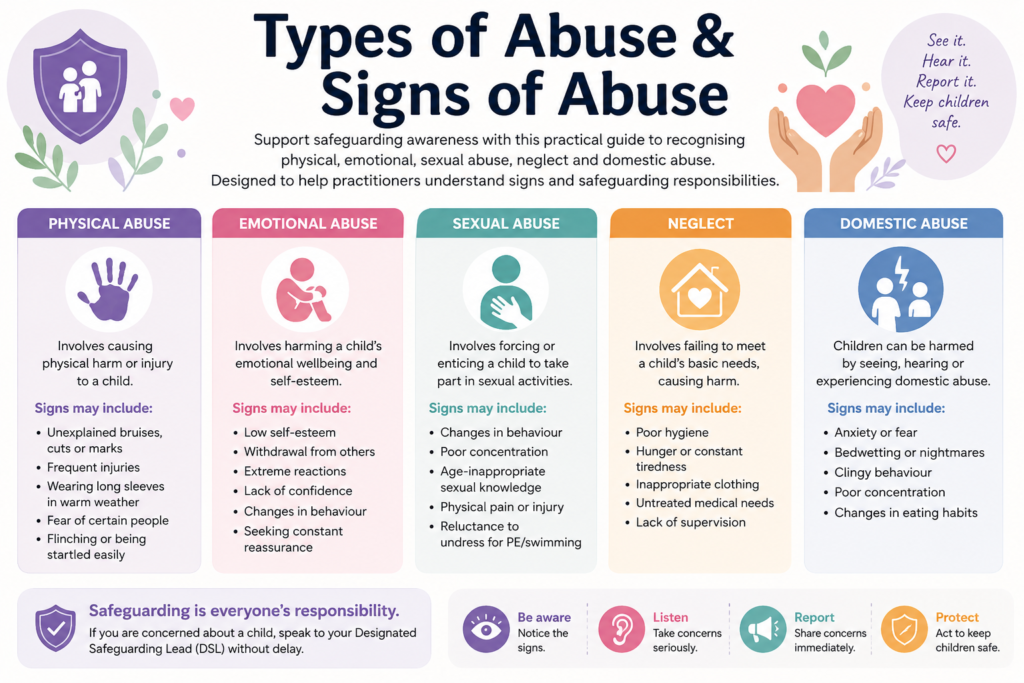
1. Physical Abuse
What Is Physical Abuse?
Physical abuse involves deliberately causing physical harm to a child. It may include hitting, shaking, throwing, poisoning, burning, scalding, drowning, suffocating, or otherwise causing physical injury.
Physical abuse can also occur when a parent or carer deliberately makes a child ill or exaggerates symptoms of illness.
Possible Signs of Physical Abuse
Practitioners may notice:
- Unexplained bruises, burns, cuts, or marks
- Injuries in unusual places, such as the neck, ears, back, or upper arms
- Frequent injuries with inconsistent explanations
- A child appearing frightened of certain adults
- Flinching when approached or touched
- Wearing clothes that cover injuries, even during warm weather
- Becoming aggressive or unusually withdrawn
Early Years Practice Scenario
A nursery practitioner notices that a four-year-old child has several bruises on their upper arms on different occasions. When asked a simple open question such as, “Can you tell me what happened?”, the child gives different explanations and becomes quiet.
The practitioner does not continue questioning the child or attempt to investigate. They record the injuries factually, including the child’s exact words, date, and time, then report the concern immediately to the Designated Safeguarding Lead (DSL).
2. Emotional Abuse
What Is Emotional Abuse?
Emotional abuse is the ongoing emotional harm of a child. It can involve making a child feel worthless, unloved, frightened, or only valued when they meet someone else’s expectations.
It may include:
- Constant criticism or humiliation
- Threatening or intimidating behaviour
- Rejection or ignoring a child’s emotional needs
- Exposing a child to domestic abuse
- Unrealistic expectations or excessive pressure
Possible Signs of Emotional Abuse
A child may:
- Have low self-esteem and lack confidence
- Be excessively withdrawn, anxious, or fearful
- Display delayed emotional development
- Use negative language about themselves, such as “I’m stupid” or “Nobody loves me”
- Show extreme behaviour, such as being very compliant or very challenging
- Have difficulty forming positive relationships
Early Years Practice Scenario
A practitioner notices that a child repeatedly tells others, “I’m always naughty at home” and often becomes distressed when they make small mistakes. During role-play, the child frequently acts out adults shouting at each other. The practitioner records these patterns and discusses them with the DSL, who considers appropriate next steps in line with safeguarding procedures.
3. Sexual Abuse
What Is Sexual Abuse?
Sexual abuse happens when a child is forced, pressured, or manipulated into taking part in sexual activities. This can include both contact and non-contact abuse.
Possible Signs of Sexual Abuse
Practitioners may notice:
- Age-inappropriate knowledge of sexual behaviour or language
- Sudden changes in behaviour or emotional wellbeing
- Fear of certain individuals or places
- Regression to younger behaviours, such as bedwetting
- Difficulty sitting or walking
- Avoidance of changing clothes or toileting routines
Early Years Practice Scenario
A practitioner observes a young child using sexualised language that is unusual for their developmental stage during play. The practitioner remains calm, does not show shock or ask leading questions, and records exactly what was said before following the setting’s safeguarding reporting procedures.
4. Neglect
What Is Neglect?
Neglect is the persistent failure to meet a child’s basic physical and emotional needs, which may result in serious impairment of their health or development.
It may involve failing to provide adequate food, clothing, shelter, supervision, medical care, or emotional support.
Possible Signs of Neglect
A child may:
- Frequently appear hungry or ask for extra food
- Arrive at the setting in unclean clothes or with poor hygiene
- Be tired or fall asleep during activities
- Have unmet medical needs
- Show delays in speech, language, or physical development
- Have frequent absences or arrive late regularly
Early Years Practice Scenario
A child arrives at the setting on several occasions wearing unsuitable clothing for the weather and appears very hungry. Over time, practitioners notice a pattern of tiredness and poor hygiene. They record their observations objectively and share concerns with the DSL, who considers the most appropriate support or safeguarding response.
5. Domestic Abuse
What Is Domestic Abuse?
Children can be harmed by seeing, hearing, or experiencing the effects of domestic abuse within their home. They may witness arguments, controlling behaviour, threats, or violence between adults.
Even if a child is not directly injured, living in an environment where domestic abuse occurs can have a significant impact on their emotional wellbeing and development.
Possible Signs of Domestic Abuse
Children affected by domestic abuse may:
- Become anxious, fearful, or withdrawn
- Display aggression or challenging behaviour
- Show difficulty concentrating or learning
- Be overly protective of a parent or sibling
- Experience sleep difficulties or nightmares
- Recreate frightening events through their play
Additional Types of Abuse and Safeguarding Concerns
6. Female Genital Mutilation (FGM)
What Is FGM?
Female Genital Mutilation (FGM) is a procedure where the female genital organs are deliberately cut, injured, or altered for non-medical reasons. It is a serious form of child abuse and violence against girls that can cause severe physical and emotional harm.
FGM is often carried out on young girls and may be linked to cultural, social, or family pressures. It is illegal in the UK and is a safeguarding concern that requires immediate action when a child is at risk or has experienced FGM.
Possible Signs and Indicators of FGM
A child may:
- Talk about a special ceremony, celebration, or a planned trip abroad that causes concern
- Be absent from nursery or school for a prolonged period, particularly after travelling
- Show signs of pain, discomfort, or difficulty sitting or walking
- Spend longer than usual in the toilet or avoid physical activities
- Appear anxious, withdrawn, or show sudden changes in behaviour
- Speak about a female family member who has undergone the procedure
Early Years Practice Scenario
A practitioner hears a parent mention that their child will be travelling overseas for a “special family celebration” and notices that the child appears worried when discussing the trip.
The practitioner does not make assumptions or challenge the family. Instead, they record the conversation accurately and share their concerns immediately with the Designated Safeguarding Lead (DSL), who follows safeguarding procedures and seeks advice from appropriate agencies where necessary.
7. County Lines and Child Criminal Exploitation (CCE)
What Is County Lines?
County Lines is a form of criminal exploitation where organised criminal groups use children or vulnerable people to transport, store, or sell illegal drugs between areas.
Children are often manipulated through threats, violence, intimidation, promises of money, gifts, or a sense of belonging. A child may not recognise that they are being exploited.
Although County Lines is more commonly identified in older children and teenagers, early years practitioners should understand the wider safeguarding context, especially when working with families who may have older siblings affected by exploitation.
Possible Signs of Child Criminal Exploitation
Signs may include:
- Going missing or unexplained absences (more relevant in older children)
- Having expensive items or money without explanation
- Becoming secretive or withdrawn
- Changes in friendships or relationships
- Increased aggression or anxiety
- Association with older individuals who may be influencing them
Family and Early Years Scenario
A nursery practitioner notices that an older sibling regularly collects a child from the setting and appears anxious, exhausted, and reluctant to speak. The family has also shared concerns about the sibling frequently going missing and returning with expensive items.
While the nursery child may not be directly involved, practitioners recognise the wider safeguarding concerns affecting the family and share appropriate information with the DSL.
8. Child Sexual Exploitation (CSE)
What Is Child Sexual Exploitation?
Child Sexual Exploitation occurs when an individual or group manipulates, deceives, or forces a child into sexual activities in exchange for something the child needs or wants, such as attention, affection, gifts, money, or protection.
The child may believe they are in a trusting relationship with the person exploiting them.
Possible Signs of CSE
Indicators may include:
- Sudden changes in behaviour or emotional wellbeing
- Receiving gifts, money, or possessions without a clear explanation
- Spending time with older individuals or unknown adults
- Secrecy around online activity or relationships
- Going missing from home or education settings
- Increased anxiety, low mood, or self-esteem difficulties
Practice Scenario
A family shares concerns that an older teenage sibling has been receiving expensive gifts from an unknown adult and has become secretive and withdrawn.
The practitioner understands that exploitation can affect the whole family environment and ensures concerns are shared through the appropriate safeguarding channels.
9. Online Abuse and Digital Safety
What Is Online Abuse?
Online abuse happens when technology and digital platforms are used to harm, exploit, or manipulate a child. This may include exposure to inappropriate content, online grooming, bullying, or coercion.
Even very young children may use tablets, smartphones, or internet-connected devices, making online safety an important part of early years safeguarding.
Possible Signs of Online Abuse
A child or family may:
- Become upset or distressed after using a device
- Hide online activities from adults
- Show unusual fear or anxiety around technology
- Display inappropriate language or knowledge beyond their age
- Have contact with unknown individuals online
Early Years Practice Scenario
A parent tells a practitioner that their child has accidentally viewed upsetting content while using a shared family device.
The practitioner provides support, discusses age-appropriate online safety with the family, and records any safeguarding concerns according to the setting’s procedures.
Quick Signs of Abuse Checklist
Practitioners should be aware of:
- Unexplained injuries or repeated accidents
- Sudden changes in behaviour or emotions
- Fear of particular people or places
- Poor hygiene or unmet basic needs
- Age-inappropriate knowledge or behaviour
- Withdrawal, anxiety, or aggression
- Frequent absences or changes in family circumstances
Recognising these Types of Abuse & Signs of Abuse early can help protect children from further harm.
10. Radicalisation and Extremism
What Is Radicalisation?
Radicalisation is the process where an individual is encouraged or influenced to support extreme ideas, beliefs, or actions that may harm others. Safeguarding responsibilities include protecting children from being exposed to harmful influences.
In early years settings, practitioners should be aware of changes in behaviour or concerning influences within the child’s environment.
Possible Signs
- Repeating inappropriate or hateful language without understanding its meaning
- Exposure to harmful materials or conversations
- Family or community concerns about extreme influences
- Sudden changes in behaviour that cause safeguarding concerns
Practice Scenario
A child repeatedly uses concerning language they have heard from older individuals at home or online.
The practitioner does not criticise or shame the child. They record what was said in context and follow the setting’s safeguarding procedures.
Why Understanding Wider Safeguarding Concerns Matters
Safeguarding is not only about recognising visible injuries. Harm can occur through emotional trauma, exploitation, neglect, exposure to violence, or other hidden experiences.
Early years practitioners must maintain professional curiosity, remain alert to changes in children and families, and understand that safeguarding concerns often overlap. For example, domestic abuse, parental mental health difficulties, and substance misuse—often known as the Toxic Trio—may increase the risks of harm to children.
At Early Years Insights, we support practitioners with up-to-date safeguarding knowledge, practical examples, and professional guidance to help create safe, nurturing environments where every child can thrive.
Remember: It is not your responsibility to investigate concerns. Your role is to observe, record, report, and act in accordance with your safeguarding policy and the guidance of your Designated Safeguarding Lead (DSL).
Early Years Practice Scenario
A child arrives at nursery tired and quiet and later tells a practitioner, “There was lots of shouting at home last night. I was scared.” The practitioner listens calmly, reassures the child that they have done the right thing by speaking, and follows the setting’s safeguarding procedures.
The Role of Early Years Practitioners
Early years practitioners are not responsible for proving that abuse has occurred. Their role is to recognise concerns, record observations accurately, and report concerns according to their setting’s safeguarding policy.
When a child shares information about possible abuse, practitioners should:
- Stay calm and listen carefully
- Take the child seriously
- Reassure them that they have done the right thing by speaking
- Never promise to keep a secret
- Avoid asking leading questions
- Record the child’s words exactly as they were spoken
- Report concerns to the Designated Safeguarding Lead (DSL) immediately
Professional Curiosity in Safeguarding
Effective safeguarding requires professional curiosity. This means practitioners should respectfully consider whether there may be underlying reasons behind changes in a child’s behaviour, appearance, or development.
Small concerns that appear insignificant on their own may become more meaningful when viewed as part of a wider pattern over time. Good record-keeping and effective communication between professionals help ensure children receive the support they need.
Safeguarding Checklist for Practitioners
Use this simple checklist in everyday practice:
☐ Observe changes in a child’s behaviour, appearance, and emotional wellbeing
☐ Record facts accurately without making assumptions
☐ Listen to children carefully and take their concerns seriously
☐ Follow the setting’s safeguarding and reporting procedures
☐ Share concerns promptly with the Designated Safeguarding Lead (DSL)
☐ Maintain confidentiality and only share information with appropriate professionals
Frequently Asked Questions (FAQs)
Understanding the Types of Abuse & Signs of Abuse enables early years practitioners to recognise concerns early and follow the correct safeguarding procedures.
How can practitioners tell the difference between an accident and possible abuse?
Children naturally experience accidents while playing and exploring. However, practitioners should consider the location, pattern, frequency, and explanation of injuries. Concerns should always be recorded and discussed with the DSL.
What should I do if a child tells me about abuse?
Stay calm, listen carefully, avoid asking detailed questions, reassure the child, and follow your setting’s safeguarding procedures immediately.
Can a child experience more than one type of abuse?
Yes. Many children experience multiple forms of harm, such as emotional abuse alongside neglect or domestic abuse. This is why practitioners should consider the whole picture.
Is it my responsibility to investigate suspected abuse?
No. The role of an early years practitioner is to recognise, record, and report concerns. Investigations are carried out by the appropriate safeguarding authorities.
Why is understanding Types of Abuse & Signs of Abuse important in early years?
Understanding the different Types of Abuse & Signs of Abuse helps practitioners recognise concerns early, maintain professional curiosity, and follow safeguarding procedures to protect children.
Scenario 1: Physical Abuse – Unexplained Injuries
Situation:
A nursery practitioner notices that a three-year-old child arrives with bruises on their upper arms on several occasions. When the practitioner gently asks, “Can you tell me what happened?”, the child gives different explanations and becomes quiet.
Professional Response:
The practitioner does not investigate or ask repeated questions. They record the size, location, and appearance of the injuries, note the child’s exact words, and report the concern immediately to the Designated Safeguarding Lead (DSL).
Scenario 2: Emotional Abuse – Negative Self-Image
Situation:
During free play, a child frequently says, “I’m naughty,” “Nobody likes me,” or “I’m stupid.” The child becomes very upset when making small mistakes and seeks constant reassurance from adults.
Professional Response:
The practitioner records patterns over time, provides a supportive and nurturing environment, and shares concerns with the DSL to consider whether further support or safeguarding action is required.
Scenario 3: Neglect – Unmet Basic Needs
Situation:
A child regularly arrives at the setting wearing unwashed clothes, appears very hungry, and often falls asleep during activities. Practitioners notice that these concerns are occurring repeatedly over several weeks.
Professional Response:
Staff record factual observations without making assumptions about the family’s circumstances and discuss the concerns with the DSL, who follows the setting’s safeguarding procedures.
Scenario 4: Domestic Abuse – Behavioural Changes
Situation:
A previously confident child becomes withdrawn, anxious, and begins acting out arguments between dolls during role play. The child says, “Mummy and Daddy shouted all night and I was scared.”
Professional Response:
The practitioner listens calmly, reassures the child that they have done the right thing by speaking, records the child’s exact words, and reports the concern to the DSL.
Scenario 5: Sexual Abuse – Inappropriate Knowledge
Situation:
During play, a young child uses sexual language that is unusual for their age and developmental stage or displays sexualised behaviour that causes concern.
Professional Response:
The practitioner remains calm and does not show shock or ask leading questions. They record exactly what was seen and heard and follow safeguarding procedures immediately.
Scenario 6: FGM (Female Genital Mutilation) – Planned Travel
Situation:
A parent mentions that the family is planning a long trip abroad for a “special celebration.” A practitioner notices that the child appears worried when the trip is discussed and mentions that a female relative had a similar celebration.
Professional Response:
The practitioner does not make assumptions or confront the family. They record the conversation factually and report concerns to the DSL, who follows statutory safeguarding procedures.
Scenario 7: County Lines & Child Criminal Exploitation
Situation:
A nursery practitioner learns that an older teenage sibling has been missing from home, returning with expensive trainers and a mobile phone that the family cannot explain. The younger child in the setting appears worried and talks about their sibling being “in trouble with older people.”
Professional Response:
Although the younger child may not be directly involved, practitioners recognise the wider safeguarding risks affecting the family. Concerns are recorded and shared with the DSL.
Scenario 8: Child Sexual Exploitation (CSE)
Situation:
A parent tells staff that their older child has become secretive, is receiving expensive gifts from an unknown person online, and is staying out late without explanation.
Professional Response:
The practitioner understands that exploitation can impact the whole family. Concerns are shared with the DSL, and appropriate safeguarding procedures are followed.
Scenario 9: Online Safety & Digital Abuse
Situation:
A child becomes upset after using a family tablet and begins repeating frightening words they have heard online. Parents report that the child may have accessed inappropriate videos.
Professional Response:
Practitioners discuss online safety with parents, provide advice about parental controls and age-appropriate content, and record any safeguarding concerns according to the setting’s policy.
Scenario 10: Prevent Duty & Radicalisation
Situation:
A child repeatedly uses concerning language or repeats extreme ideas they have heard from older individuals, media, or online sources without understanding the meaning.
Professional Response:
The practitioner does not criticise or punish the child. They record the language used, consider the context, and share concerns with the DSL.
Scenario 11: The Toxic Trio – Multiple Family Difficulties
Situation:
A child regularly arrives tired and anxious. Staff become aware that there are concerns involving domestic abuse at home, a parent’s mental health difficulties, and substance misuse.
Professional Response:
Practitioners recognise that the combination of these factors may significantly increase the risk of harm. They maintain accurate records, work with the DSL, and follow safeguarding procedures.
Professional Reminder for Practitioners
A safeguarding concern does not require proof of abuse. The role of an early years practitioner is to:
- Recognise signs of concern
- Respond appropriately and listen to children
- Record facts accurately
- Report concerns to the Designated Safeguarding Lead (DSL)
At Early Years Insights, we believe that professional curiosity, accurate record-keeping, and timely action can make a life-changing difference to children and families.
Further Safeguarding Resources
For additional guidance and professional support, early years practitioners can refer to:
1. GOV.UK – Safeguarding and Child Protection Guidance
Text to use in your article:
Practitioners should always follow current safeguarding legislation and statutory guidance provided by the UK government.
Link:
GOV.UK Safeguarding Guidance
2. NSPCC – Child Abuse and Neglect Information
Text to use in your article:
Further information about recognising abuse, neglect, and keeping children safe can be found through NSPCC child protection resources.
Link:
NSPCC Child Protection Information
3. Working Together to Safeguard Children (Statutory Guidance)
Text to use in your article:
The Working Together to Safeguard Children guidance explains how organisations and professionals should work together to protect children.
Link:
Working Together to Safeguard Children Guidance
Link to your existing Early Years Insights articles:
Final Thoughts
Understanding Types of Abuse & Signs of Abuse is a key part of effective safeguarding practice. Early years practitioners must remain alert to signs of harm and respond appropriately.
Recognising the signs of abuse is an essential part of high-quality safeguarding practice. Early years professionals have a valuable role in noticing when a child may need help and ensuring that concerns are acted upon appropriately.
At Early Years Insights, we believe that confident, knowledgeable practitioners create safer environments for children. Through ongoing training, professional curiosity, and a strong safeguarding culture, every practitioner can contribute to protecting children and supporting their wellbeing.
Remember: safeguarding is everyone’s responsibility, and even a small concern can be the first step towards protecting a child.